Wednesday, October 1, 2014

TV ON THE SUPERMARGINS WITH GOTHAM AND AGENTS OF SHIELD

gotham

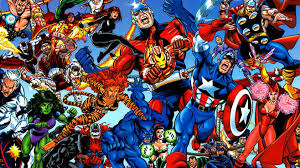
Having thoroughly conquered the multiplex, superheroes are now invading television in greater numbers than ever before.  Both Marvel (via ABC and Netflix) and DC (via the CW and Fox) are putting their characters on smaller screens.  With Marvel, I have a lot of curiosity and a decent amount of hope for the Defenders Netflix miniseries, but Agents Of SHIELD still struggles to make either its original heroes or D-List superbeings pop onscreen.  And unfortunately, it’s still carrying the standard for the House Of Ideas on the TV front.  But while DC has done well for itself with a lesser hero in the genre pond of the CW, it is now stepping it up by taking to a “proper” network with their crown jewel, Batman.

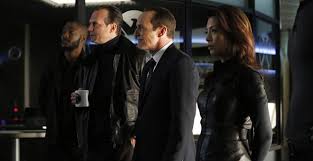
Sort of, anyway.  Gotham is a strange beast in that it’s a Batman series that has cut itself off from actually using Batman.  Agents of SHIELD has a similar issue conceptually, and offers little in the way of examples for how to construct a series whose appeal is based on being part of a greater, more colorful world without being able to actually use the best, most colorful pieces of that world.  This is a spin-off problem.  Try and explain why I should want to watch Gotham/AOS without mentioning Batman/the Avengers.  It’s not easy to do, right?

Still, this is not insurmountable. There are positives to Gotham’s concept, in that Jim Gordon is an inherently better character than Phil Coulson, and more important to his respective mythos. Also, Batman has by far the best rogue’s gallery in the history of comics, which goes a long way towards making Gotham the most fully realized setting in the medium.  And apparently Gotham Central has been one of DC’s best books of the last decade, so the GCPD is fertile enough ground for ongoing stories.

There’s still quite a bit wrong with Gotham’s basic premise, don’t get me wrong. But the problems aren’t spin-off problems, they’re prequel problems. Gordon’s rise paralleling Gotham’s fall is rife with potential, as is the dramatic irony of his ultimate triumph over the traditional mafia clearing the way for the takeover of the freaks that make Batman necessary (though that’s probably series-finale sort of stuff).  No, the problems with Gotham arise from the decision to set the series so early in the timeline that neither Batman nor any of his major antagonists are anywhere near the portion of the story when they become the figures that actually make this story interesting. Chud message board luminary The Prankster had the following to say, which I will simply quote instead of paraphrasing:

The “prequel problem” is thus: most stories, if they’re at all well-constructed, start at the point where things get interesting for the protagonists or the world of the story. This means that, almost by definition, the stuff that came before is going to be less interesting. There’s a website called Wordplayer run by screenwriters Terry Rossio and Ted Elliot, and whatever you think of those guys they make some great points about how stories are constructed. One of their essays is about the “off-screen movie”, and the importance of creating a story where things are happening that we DON’T see, either parallel to the main action or before the events of the story (or, for that matter, afterwards). When you fill in all the blanks, you ironically remove depth from characters and the story, because you create the impression that nothing happens to these characters when you’re not looking at them, and thus, the story seems inert and unreal. They used the example of a character who execs insist be given more “screen time” but had nothing to do. Before, she would pop in and out of the story and create mystery; with the added screentime, she was established as a character who hung around and didn’t do anything.

This principle applies to prequels. Part of the fun of Star Wars is that it creates a huge, rich world full of history that’s glancingly mentioned but creates the impression of (pseudo-)reality. When the prequels went back and showed us everything, it destroyed this sense.

Stories “start at the point where things get interesting.”  Isn’t that how it’s supposed to be? So why the infatuation with prequels and “secret origin” stories of late?  I guess it’s not overly complicated.  Everyone wants everything to be a neverending franchise, a perpetual cash generator, and so the desire is to start at the beginning and never get anywhere close to an ending.  That’s a model that has reaped great rewards for both network television and the comic book industry over the last century, and a show like this represents the merger of those two great American artrevenue formstreams, so this probably isn’t anything to be that shocked about.  But while this approach has done very well financially for these media, it’s hard to deny that it has been a hindrance creatively.  A story is not a story without an ending, not really, which is a large part of why things like superhero comics, daytime soaps, or Republic serials, for all their popularity, are not considered high art.

Does Gotham have a proper story to tell, one about its city and its police?  Can they manage to tell such a story in a way that focuses on what it means to Gordon, rather than setting the table for the actual hero waiting in the wings?  That remains to be seen, but things get off on the wrong foot straight out of the gate.  This is a show about Gordon, and we aren’t even introduced to him until after an extended sequence depicting the murder of Batman’s parents…told for some reason, through the eyes of a tween Catwoman**.

Look, I know that they have to depict this bit of the iconography, and it may seem like a minor point to harp on.  But introductions are extremely important, and the 2nd episode repeats the mistake by once again opening on Baby Bruce Wayne before moving on to the cops and crooks that he can’t really interact with, the ones who, oh yeah, also make up the main body of what this show is and has to be.  What’s worse is that our actual intro to Gordon, when we get to it, isn’t half bad.  He’s confronted with a criminal of a lunatic variety that the rest of the police aren’t prepared for, and once his decency and level-headedness defuse the situation, the corruption of the force immediately reasserts itself and wipes out his good deed.  That’s the story the series is telling in a scene.  But unfortunately, what it showed us is that embryonic Batman and Catwoman take precedence.

This premise is all wrapped up in the Batman mythos, obviously, but that premise is also that we will get to see Gotham develop slowly over time into the madhouse we know from so much other media.
A more specific problem with prequels is that they so frequently lose track of their own story in the rush to cram in a bunch of references that carry no more weight than a wink, and tie off loose ends that weren’t actually loose.  X-Men: First Class was a largely successful reboot and prequel, but a lot of the goodwill it builds over its runtime  is squandered by the ill-conceived sequence on the beach at the end.  The movie has largely completed its own story, but there is a palpable sense of panic that sets in at the last second, a desperation to shove all of the various characters into the precise positions we’ll find them in 40 years later, in the span of a few minutes.  I suppose it’s hard for a project whose whole raison d’etre is to fill in gaps to accept that there are some gaps that it is okay, even preferable, to leave open, or else you run into the flattening effect Prankster referenced above.  I mean, c’mon, 40 years?  We can do some math ourselves.

Are Gotham’s first couple episodes on this level?  No.  But they do go overboard giving time to Baby Wayne, Kittenwoman, proto-Penguin and Riddler, a potential Joker, etc.  This is a problem on several levels.  In the broadest conceptual terms, the more this show allows itself to be “about” the larger mythos, the more it drives home the point that it can only show us the stuff we’re really interested in before the point where it gets really interesting.  On a smaller level, the arc of the season(s) is going to be for us to see the rise of the freaks, and the pilot probably went too far on that score for what should be a very gradual process.  But that’s not an uncommon issue for pilots; in their eagerness to sell their basic dramatic engine and conceit, they’ll frequently overreach, resolve a bit too much and then have to walk things back to a place from which viable storylines can spin out on a weekly basis.  The pilot of The Shield is a good example in this regard – it packs an explosive finish that definitely digs its hooks in deep, but it will be years of slow building before Mackey gets back to a level of villainy on par with that displayed in his introduction.

Agents Of SHIELD has the same problem, shifted slightly over.  Gotham hamstrings itself by placing its action too far in front of the main event, whereas AOS places its action just to the left of the real attractions.  The result is two shows struggling to live in the shadow of their progenitors, without moving too far from the warm, comfy glow of brand recognition that resides at the heart of this mixed metaphor.  Now, I’m a lifelong and unabashed Marvel zombie, but for this reason I am much more hopeful about Gotham’ s prospects than AOS’s.  It’s true that AOS saw an uptick in quality once their status quo was forcibly overthrown by the big screen upheaval of The Winter Soldier, but it’s still little better than tolerable on its good days and really, how good a sign is it that such a desperately needed course correction had to be foisted upon it by the mothership?  I’d love to be wrong about this, but I think we’ve seen pretty close to the best this show will ever have to offer us, and it’s just kinda okay.

Similarly, I’d love to be proven wrong about Gotham’s premise putting it in an insurmountable hole, but I also see more reason to think that might be the case.  For one, I have a decent amount of faith in showrunner Bruno Heller, whose Rome was one of HBO’s more unappreciated efforts, and demonstrated a facility I think will be vital for pulling off the tone this show is going for.  Rome tackles material that has both the gravity of history and the grandeur of myth, but Heller grounded it in a pulpy sensibility that kept things fun and lively without skimping on the brutality and ahem, adult situations that we demand of an HBO original.  It got to have its pulp and its gravitas too, in a way that was ultimately quite enjoyable.

How this relates back to Gotham is that it is going for a similar balancing act with more overtly clashing tones.  Right out of the gate it is mixing the lurid theatricality of the Burton films on the villain side of things with a throwback 70s vibe on the cops’ end, where Gordon’s material so far owes more to Serpico than anything Bruce Timm has done.  Rome tells me that Heller understands that the words “grim”, “gritty” and “realistic” are not interchangeable.  Gotham needs to be gritty, but not realistic, and that’s a distinction few seem interested in parsing.

Because here’s the rub: this needs to be a show where guy named Oswald Cobblepot can kill people with an umbrella, and sooner or later a mafia enforcer turns up half crocodile.  But in order for the show to tell a real story about its main character, it also has to remain a show about a good man’s failure.  That Gordon is doomed to fail to save his city does not doom the series; there is nobility to be found in a losing fight, perhaps more than any other.  But that’s a tough narrative ball to keep your eye on, particularly when you’re occupying a primetime network spot trying to skew broad with what is ostensibly a children’s property.

Also giving me hope is Ben McKenzie and Donal Logue’s immediate chemistry (which duh, it’s Donal Logue, dude would have chemistry with a hemorrhoid pillow), as the square jawed idealist and slovenly realist who would make a great buddy cop pairing if their dislike of each other didn’t feel so genuine, and Bullock’s defeatism so lived in and sincere. He doesn’t even hate his partner; he just knows the fight is already lost.

I also took an immediate liking to the less-familiar villains, Fish Mooney and Carmine Falcone, who embody the camp and gravitas the show needs to balance.  Mooney is the show’s most significant original creation, and Jada Pinkett-Smith devours scenery like she’s facing the electric chair in the morning.  It’s kind of wonderful, and provided a nicely grounded counterpoint by the late-pilot entrance of Falcone.  It’s important that these characters work, because they are small enough fish in the grand scheme of things that Gordon can score some actual wins by taking them down, which is going to be a rare but necessary thing if the show is going to continue to be swarmed with Penguins, Ivys, Riddlers, etc.  But Falcone is especially significant because of what he represents.

Falcone’s role in the mythology is that of the last traditional mafia don to fall to the rising tide of freaks in Gotham, and that is obviously going to be a big part of the show’s overall arc.  As previously mentioned, endings are a vital part of storytelling, and this angle allows a show permanently mired in the beginnings of a story to be about the end of something.  John Doman brings a weathered authority to the role, and in his brief talk with Gordon presents a genuinely interesting angle for the character.  Falcone styles himself as part of Gotham’s gentry; the least reputable, sure, but just as vital protector of the status quo and law and order (which, he avows, you can’t have organized crime without) as the vaunted Thomas Wayne.  What this does is set up Gordon and Falcone as the old guard, destined to be supplanted by Batman and the Joker at the vanguard of Gotham’s war on crime.  The Joker famously just wants to watch the world burn, but Carmine sees crime as having a purpose (even if it’s just profit), to the point that his involvement in the framing of Pepper is motivated by a desire not to let the Waynes’ murder spark a fire that will destabilize the city.

I really like the dynamic this sets up, and the dramatic irony created by having Gordon take down the devil he knows, while only we know how much worse the replacement will be.  But whether Gotham follows up on the promising tracks it lays in these first 2 episodes, or ultimately drowns itself in references to a more interesting story than the one it’s telling remains to be seen.  I’ll give it a season to find out (Logue alone is worth that), and perhaps keep checking in on it and/or AOS’s progress, if they start succeeding, or failing in an interesting enough way. Unfortunately, neither show is doing either just yet.


*I haven’t seen Arrow, but am told its fun and is successful enough to have back-doored a series for a slightly bigger name in the Flash

**Sidebar: her intro sequence rings abjectly absurd due to entirely unnecessary prop choices. Selina tears open the bag of a society lady, who, as they are wont to do, is grocery shopping late at night in the theater district. Said grocery bag spills out naught but two half gallons of milk, one of which she snatches up. She then ducks into an alley, and goes to pour some out for a stray cat from a jug that is suddenly 7/8 empty.  I just…why any of this? Just too expensive to shoot a stunt-pour from a full bottle?

Saturday, August 9, 2014

RANKING THE MCU

mcu

I was a Marvel geek as a kid, and I pretty much love the current wave of movies they have put out.  Having just seen Guardians Of The Galaxy, I thought I’d use this space to talk about it a bit, see if I can get into the heads of those that dislike the MCU in general, and of course do the ranking thing, because this is the internet, and the internet don’t take kindly to opinions what don’t come in list form.

11. AGENTS OF SHIELD

aos

I’ve written about my problems with this show before, but this is just a remarkably small, unimaginative show to place in such a colorful, expansive universe.  It made some strides at the end of the year, post-Winter Soldier, but the characters remain bland and undistinguished, the dialogue routinely falls flat, and the production values are embarrassing.  It’s only bone-deep Marvel partisanship that will bring me back next year.  They’re adding Mockingbird, guys!!!

Guys?

Guys???

10. Iron Man 2

im2
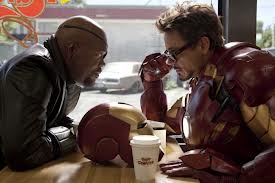
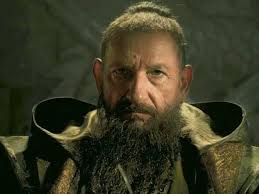
The complaints aren’t wrong.  It’s too concerned with setting up the shared universe, at the expense of its own story.  Which is true but not as big a sin as some make out – the shared universe is at the heart of what makes these movies special in spite of the fairly rigid formula and frequently lackluster villains.  That’s another critique that comes up for this film, which is only partially accurate.  The villains are actually pretty good, and have distinct motivations that go beyond “get magic rock, destroy world”. But Rockwell is having too much fun to be menacing.  Although he may just be further ahead of the curve than Favreau or his studio overlords were at this point; as time goes on, it becomes more and more apparent to me that these movies are as much comedies as they are EPIC ACTION SAGAS (something DC seems determined to deny, to their overall detriment).  Rockwell is giving a performance for an 80’s comedy, someone who wants to bulldoze the rec center, not rule the multiverse.  Unfortunately, Rourke is also underused as the legitimate threat, and his backstory actually makes him the scrappy underdog to Tony Stark’s trust fund D-Bag, which feels a bit off.  Also, it suffers from speeding through some potentially rich Tony/Rhodey conflict with a newly recast Cheadle, who hasn’t had time to settle into a groove with Downey.

But in the end, there’s only so bad you can make a movie with that cast and suits of over-weaponized flying armor. This is the bottom of the heap for the films, but still slots in just fine on FX’s Sunday afternoon hangover rotation.

9. The Incredible Hulk

hulk

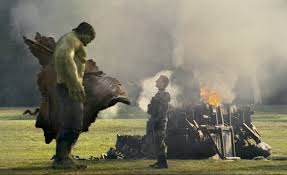
Probably the most forgettable of the bunch, due largely to none of the principals making it out of Phase I (though there’s technically nothing to stop the Abomination or Tim Blake Nelson’s Leader from joining Red Skull, Loki and whoever else in a Masters Of Evil movie down the line).  It does have a pretty great action sequence, though true to what will become form for many of these flicks, it comes in the middle rather than the climax.  And it has an underrated villain, with distinctive motivations, in Tim Roth’s Blonsky.  As mentioned, one of the biggest gripes with the Marvelverse is the generic baddies, but looking at my rankings, I’m struck that the ones with the best realized villains are crowded near the bottom, and my favorites overall tend to have the most standard “KILL ERRYBODY CUZ YAY EEEEEEEEEEEVIL” schemes.  Which underlines just how much these movies live by their heroes, which they are universally nailing….with the exception of Norton’s Banner.  He’s perfectly serviceable, and honestly makes more sense as a physical presence than either Bana or Ruffalo, but the latter just managed to resonate with audiences in a way that Norton didn’t.  Though to be fair, he never got to work off Downey, Evans, or even Sam Jackson.

8. Thor

thor
There are a few Marvel movies that I’m just amazed work on any level, much less found a real degree of mainstream acceptance.  Of them, Thor is both my least favorite and probably most miraculous, if only for coming first.  The problems it has are really quite glaring.  Arbitrary, distracting Dutch angles.  One of the few casting bum notes (not that it isn’t perfect on paper) in the MCU with Anthony Hopkins’ lethargic performance.  An almost grindhouse-y budget consciousness that sends a truly cosmic storyline on an extended detour to a deserted backlot.  A glaringly tacked-on introduction of Hawkeye that can’t even manage to look cool to counterbalance its utter superfluousness.

But what it nails is the big stuff that saves even these lesser efforts – tone and casting.  Thor was always my least favorite character in the comics, combining about all the worst aspects of superheroes.  Overpowered a la Superman (he’s literally a god, after all), with an unappealing combination of low IQ and high ego, and a costume that stands out as overly goofy even when sharing a panel with Captain America and Quasar.  But Chris Hemsworth was a hell of a find, not just because he could make the ridiculous Technicolor toga sexy.  He finds a real heart to the Odinson that I never saw on the page, and gives him a genuine sense of humor despite most of the humor of the character being of the unwitting kind.  And he’s matched at every step by Tom Hiddleston’s Loki, the most unlikely breakout star of the whole shebang.  He’s sly, he’s funny, he’s tragic without ever becoming fully pitiable.  I don’t want to start throwing the word “Shakespearean” around, because I don’t think I really know what it means in this context, but suffice to say that the relationship between the brothers is a wellspring of both humor and something approaching gravitas.

7. Iron Man

im
This is many people’s pick for best of the bunch, but that’s mostly because it came first, in my opinion.  That’s a perfectly good reason, as it means that the elements it shares with its descendants are freshest, but also roughest around the edges.  The action beats are more fun than exciting, and it peaks well before the climax, but the groundwork for everything is laid here, including Robert Downey Jr. effortlessly establishing that Marvel Studio productions are, for all their CGI boomsplashery, modern film’s most pure star vehicles.  It’s his very particular charisma that carries the film as a stealth comedy, and made us even kinda like Gwyneth Paltrow again.
Ultimately, though, I look at this like a great TV pilot. It can be really good, but it doesn’t (and shouldn’t, really) represent the very best of what the series is going to be capable of, if it is to run for a dozen plus more entries.

6. Captain America: The First Avenger

cap

This is the first Marvel movie to garner bonus points for deviating from the established tone and setting of the MCU.  Now, there are some who say that the differences are “merely” cosmetic, that this is just every other Marvel movie, transplanted to 1945.  A similarly themed debate is currently going on about how Guardians Of The Galaxy is just “surface weird” or “colorful” and not genuinely weird because it has a traditional 3 Act structure built around a shameless Macguffin.  I can only surmise that to some, words like “weird,” “creative,” “personal,” “innovative,” etc. only apply to films that feature entirely original characters with no recognizable relation to established archetypes, and creates an entirely new setting with no discernible influences from scratch, while utterly disregarding every convention of dramatic storytelling. Which are all fine goals, but if you try to do them all at once, you’d end up with an unwatchably incoherent, plotless, paceless soup (or maybe a Jodorowsky movie, if you’re really lucky).  It doesn’t mean that movies that mix up a formula by introducing a throwback vibe or a talking raccoon as a major dramatic character aren’t taking risks.  It’s just that the magic of hindsight has a way of making any risk that paid off into a boring, safe, obvious choice.

Which is to say, it’s remarkable in general that Marvel has been able to drag the mainstream to a place where they accept their sentient tree and jock-y magic psuedovikings spouting pseudo-Olde Englishe as legitimate heroes.  And it’s remarkable in particular that Chris Evans and Joe Johnston were able to get them to embrace such a square, old-fashioned hero in the age of the antihero.  Sure, the movie relies a bit too heavily on montages for action beats, and it doesn’t use Hugo Weaving to the best of his cartoon-villainy abilities.  But Evans and Atwell bring a ton of personality to a very sweet, chaste, ultimately sad romance, it fully commits to being a throwback piece, and allows Captain America to endear himself to us the old-fashioned way: by punching Nazis.  And yes, I know HYDRA are not really Nazis in the film.  They’re more like uber-nazis that think the SS are too pansy, which is just as good.

5. Thor: The Dark World

thor2

I don’t remember the specifics of this movie too well a year later.  But I remember that I was thoroughly entertained throughout, and laughed a ton.  I remember that the bad guys had a great design but little personality, a victim of Loki’s breakout status.  Which is a fair trade-off, imo; Loki and Thor’s dynamic is the best part of this sub-franchise by far, and as discussed earlier the alchemical secret that Marvel has uncovered is how to not make the villains matter too much to the overall strength of the film.  I’m still puzzling over how that works, actually.  All other superhero movies I can think of, most notably the Batman and James Bond franchises, really live and die on the strength of their villains.  It’s not even just superheroes; even at this point I’m hesitant to say that you can make any sort of decent fantasy/action movie without striking villains (if you want a single sentence explanation for what makes the original Star Wars trilogy so much better than the prequels, that’s as good as any).  But here these 10 movies are, with about 2.5 effectively realized baddies between them, and me either kinda liking or outright loving every last one, like some sorta sucker.

Maybe it’s something about having a hero that is so fully formed and engaging that you don’t even need a full on nemesis with their own POV to depict their character. It’s enough to put them in front of a really steep hill and watch them struggle to climb it. If you think about it, the main conflict in the Avengers doesn’t arise from wondering how the team will ever be able to overpower Loki.  It comes from the question of whether they’ll be able to get out of their own ways in time to kick his ass (which several of them can, and do, by themselves).  And the entire Iron Man series up to this point has been populated with villains that are riding the hero’s coattails in terms of creating weapons to challenge the ones he already has.

Or maybe it’s just that these movies really are just comedies, where truly imposing villainy is secondary to general flair.  This thesis is still under construction.

4. Iron Man 3

im3

The best thing about the Iron Man movies is that they felt like ersatz Shane Black movies.  So it stands to reason that the best of the bunch should result when they just cut the shit and brought Black himself in.  The climax is a little overly busy, in a bad, weightless way (as opposed to Thor 2’s overly busy, but fun and inventive climax), and I am annoyed by how transparently they went for the Pepper death fake-out (a comic trope that is no less shitty for being “classic”, and is already getting overused in the films).  But…it’s funny.  And surprised me way more than these “cookie-cutter” productions are supposed too.  Particularly with everything involving Trevor Slattery, which was sort of genius in how it elided a troublesome bit of comics history, but also, come on, “His Lear was the toast of Croydon” is just a funny string of words, whether you understand the actual idea they’re supposed to convey or not.

I guess by the 8th time out, this isn’t exactly rocket science.

3. Captain America: The Winter Soldier

cap2

I’ve been talking about how these movies work largely based on their comedic chops, and more or less despite the effectiveness of their action and suspense beats. So naturally, when you bring in a pair of directors whose primary credit is from the (transcendent) sitcom Community…you wind up with one of the least comedic efforts, with the best shot action in the entire MCU.  Shrug.

Having succeeded making First Avenger a throwback to 40’s war movies, they naturally went on to make Winter Soldier a throwback to 70’s conspiracy thrillers. One can only imagine that in 2017, Captain America: Serpent Society On A Plane will be a throwback to 90’s slacker comedies, with Cap sharing an incongruously-spacious loft space while struggling to get their boutique record label off the ground, and Sam has to gently push Cap to stop denying his feelings for Black Widow and eventually parachute in to interrupt her wedding to Quicksilver….

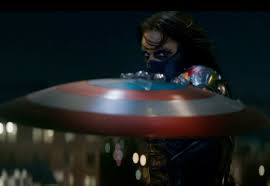
Anyway, Winter Soldier.  It underuses the titular figure by relegating him to a mute henchman role, seemingly afraid to push him too far into villainy before the inevitable redemption arc.  Which is not too terrible, as his action sequences kick enough ass to make up for it.  The only really bum note is the elaborate Fury death fake-out, which is a load of shit, because if any of the “major” heroes is actually expendable to the MCU going forward, it’s that guy.  But it also effortlessly nails the introduction of Falcon, integrates Black Widow well, and succeeds in turning Captain America into something approaching an ensemble piece.  And I’ll take one of those over a one-man show every day of the week.  It’s probably why the widely-favored Iron Man movies rank comparatively low for me, and why my top two spots are reserved for:

2. Guardians Of The Galaxy

rock

I loved this movie.  It’s colorful and goofy and fast-paced and heartfelt at the right moments (things got a bit misty at Groot’s last line, and at the moment where Rocket lets Drax pet him, and not only because I was half drunk).  And I’ll acknowledge most of the complaints, or at least the ones that don’t revolve around everyone thinking they are experts on the effects of human exposure to the vacuum of space.  Yes, Ronan is thinly sketched bad guy.  Yes, the Infinity Stone is a particularly naked Macguffin; it’s even lamp-shaded with a line*.  Yes, the climax is straight out of the Care Bears.  Yes, Thanos does nothing but sit and look kind of dumb.  Actually, that last one does bother me a bit. T hey have not done well building up Thanos so far, though I suppose they have another 4 years to work out the kinks before he has to take center stage.

But here’s a few ways to get me to overlook any flaws your movie might possess:

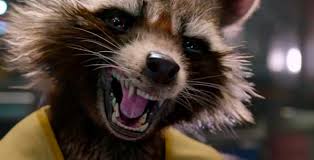
–   Include a talking raccoon as a major character, and not have him be a joke sidekick, but basically the Han Solo of the group.
–   Put a combination jack-off joke/Jackson Pollock reference in a family film. I spent the next 5 minutes cackling while thinking about all the parents in the audience wracking their brains trying to figure out how they were going to explain that when their 8 year-old asked why it was funny.
–   Balance your ensemble well. Give everyone a purpose, a personality, and some moments to shine. Guardians has to introduce 5 different heroes, none of which have any mainstream cache, but it is one shiny-ass movie from top to bottom.
–   Have Zoe Saldana kick ass in green body paint. Look, I told you not all of this was rocket science.
–   Set a good chunk of a movie in the severed head of a dead god floating in outer space.
–   Have a running gag about the heroes stealing prosthetic limbs from handicapped people, for no real reason.
–   Keep it to 2 hours. Seriously, not everything is an epic, particularly comedic action romps.
–   Howard the Duck easter egg. This is kind of a no-brainer in a Marvel movie, but it applies all the same to westerns, erotic thrillers, and period musicals.
–   Have the hero challenge the evil space overlord to a dance-off.
–   Have Michael Rooker play an asshole.  If he’s painted a stupid color, all the better.
–   End in a big Care Bears climax.  Seriously. It’s hokey, but I’m a sucker for stories about ragtag groups pulling together to do things they could never accomplish on their own.  Fantasy stories like this can make that theme very literal, and I’ll fall for it pretty much every time.  I am a skeptic by nature.  I do not believe in gods or ghosts or magic or reincarnation or Celestials.  But I do believe in a very specific kind of alchemy, a mysterious process that happens when people come together and become more than the sum of our parts.  There can be a weight that I could never hope to lift, that would crush me into the ground if I tried to shoulder it.  But give me one good friend, and together we can carry five of them.  It’s nonsensical, it’s sappy, it’s neither grim nor gritty nor grounded, but it is always going to resonate with me. Because it’s the one kind of magic I believe in.

1. The Avengers

aveng

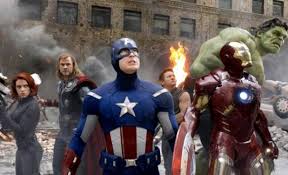
Guardians may get off to a stronger start, but I can forgive a wobbly start very easily if it leads to a strong finish, and The Avengers has the strongest finish of any superhero movie…yeah, just any.  Even the best of the genre, like Spiderman 2 and The Dark Knight, blow their big action load before getting to into an entirely new sequence for the emotional climax.  And as wonderfully as Guardians introduces and integrates each member of its team, their coming together can’t match the momentousness that comes from bringing together multiple established franchises in such a shockingly coherent, effortless, and fun way.  I’ve gushed at length about the amazing high-wire act The Avengers makes look easy, but I’ll just add that another of its accomplishments is to make the most entertaining scenes come from the heroes bickering with each other.  We’ve already become attached to each of these heroes individually, and it’s no mean feat to make these clashes pop while not making any one of them act out of character or into the “jerk” for the purposes of a particular argument.

Also, Avengers has a Hulk.  And it’s not afraid to use it, but also has the discipline to withhold it until the moments it will have maximum impact.  And it has the best Marvel villain running around with Loki, and Thanos still removed enough to be mysterious rather than looking silly and nonthreatening.  Plus, for no real reason, cameos from Harry Dean Stanton and Powers Boothe.  But mainly, it’s got great action, great characters, and is really funny.  To the extent that Marvel has a secret, that’s about it.  It’s about having a good time with charismatic heroes.  It’s not dark or edgy or even “cool” really, but it is simple and fun and good-natured in a way that maybe even holds them back from creating truly memorable, hateful villains, but also makes all the shortcomings easy to overlook.

For me, anyway. Your mileage probably varies, but that’s only because you’re probably an asshole.

Love and kisses,
Schwartz

*which includes a reference that has bothered some, since Pulp Fiction came out after Quill left Earth, but given that Earth and its culture are not unknown or inaccessible to the rest of the galaxy, it doesn’t feel worthy of a No-Prize to concoct as scenario where he might have seen the most popular movie of the 90s

Tuesday, June 17, 2014

GAME OF THRONES 4.10 - "THE CHILDREN"

throne

I’ve made a few references in the past to “Blackwater” being the best episode Game Of Thrones was ever likely to produce, but it’s possible that “The Children” may have surpassed it as my favorite.  It’s not as focused and cohesive as the big battle episode, but then I maintain that the series’ appeal actually derives in large part from its lack of such attributes.  In seasons past, the major fireworks went down in the penultimate episode, with the finale being a rapid reworking of the board that felt more like a traditional premiere.  But while “Watchers On The Wall” delivered the major spectacle, it has nothing approaching the far-reaching consequences of the series of climaxes that fill “The Children”.  And, it must be said, a lot of my love for the episode flows from the immense sense of relief that Tyrion, Brienne, and all of the other sympathetic characters had made it out alive.  I’m sure that Season 5 will contain its share of horrors (not least of which seems to be some sort of FrankenMountain), but it is also poised to offer us Tyrion, Varys, Arya and Jorah in a single scene.  Never did I dare to dream of such a treasure.

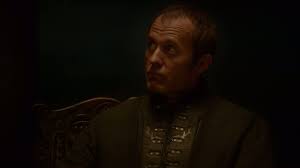
But let’s focus on things that have actually happened first.  At the Wall, Stannis rides in to save the day, as anticipated.  Stannis has never been my favorite, but an influx of fresh blood is precisely what the Wall needs to stay at the level it has spent the past season clawing its way up to (which would be “better than Dragonstone or the Dreadfort, not as good as anything else,” if we’re getting technical).  And I do like that the Boltons are now sitting between him and the rest of the nation he intends to rule.  I mean, he must have ships that could just sail around to King’s Landing, but he’s not exactly known for picking his battles based on expedience.

The face of a man who wipes exactly three times, no matter the circumstances or consistency
This is the face of a man who allows himself exactly three 
wipes, no matter the circumstances or consistency at issue
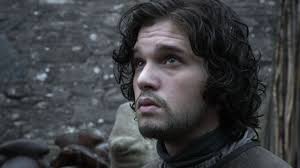
But the character stuff trumps the plot developments up North, which is surprising since it’s focused on Jon Snow.  Jon has developed into one of my favored, if not favorite, characters throughout the year.  He has really come into his own, demonstrated by the way he coolly gives orders to “One True King” Stannis, his thoughtful talks with Tormund and Mance about the finer points of mourning and kneeling, and my favorite exchange of the episode, in regards to the fallen giant:

“He was their king. The last of a bloodline that stretches back before the First Men.”
“Gren came from a farm.”

I know Gren didn’t make much of an impression on most people, but I’ve been surprisingly moved by his sacrifice, once again this week when even Mance honored it with a toast.  What can I say? I’m very much a second son, and always more drawn to sidekicks and simple men stepping up to huge plates that they didn’t have to, rather than the protagonists with the stink of destiny all over them.

Destiny and a lilac emulsifying conditioner
So it would stand to reason that I was also moved by Jojen Reed’s death, but…nope.  I don’t know what the deal was there.  He wasn’t an unsympathetic character, but I had him marked for redundancy and death from his introduction, and I never got a sense of who he was beyond the guy who knew the basics of warging.  Which is a fairly simple concept anyway.  But even if I don’t mourn Jojen, I did enjoy the sequence that offed him.  It marked Bran officially wandering into a D&D module, complete with giants and wolves battling skeleton warriors (that move with a frightening speed compared to the shambling White Walker zombies, though I assume both get marching orders from the same place), wizened sages spouting cryptic prophecy, and an elf child who apparently studied Prodigal Sorcery under Tim The Enchanter.

If that paragraph made perfect sense to you, you have fully and objectively wasted your life
If that last sentence made perfect sense to you, 
you have fully and objectively wasted your life
This is fun stuff, and all but confirms that Bran is going to warg his way into one of Dany’s dragons in the end.  Possibly the big one, as it has gone rogue, roasting kids and prompting the khaleesi to lock up the other two in the catacombs of Mereen.  This is not the most dramatic development of the week, but I do wonder if maybe the episode should’ve ended on this note instead of where it did?  I’m a much bigger fan of Arya than Dany in general, but her standing on a ship deck is not the most striking image on which to close such an explosive finale.  Whereas there is a tradition to be upheld in having seasons end on shots of dragons or White Walkers, and they really outdid themselves with the sound design of the beasts keening after their mother.  I dunno, I just felt like something more fantastical than a sailboat was called for.
But I don’t want to begrudge Arya or Maisie Williams their big moments.  While I was disappointed that she did not take up Brienne as her new mentor, having her ship off to Braavos (the most badass, underexplored corner of the map) is a fine alternative, and the brawl between the Hound and Brienne was somehow even more brutal and awesome than the Mountain vs. the Viper or any other action the show has ever done.  This is exactly the sort of showdown that I’ve talked about in prior weeks, where we have 2 evenly matched opponents who both feel like they could plausibly get the upper hand on the other at any point, and despite audience loyalty to both, and it most definitely did not end in a draw.  And so I was a nervous wreck throughout, waiting for Pod to interfere and get himself killed giving Brienne the opening she needed to prevail.  Which made it all the sweeter when that didn’t happen, of course.  I mean, I liked the Hound as a character, but guy was an unrepentant murderer of children.  It would’ve been a much bigger bummer to see Brienne take the loss.  And that last scene between Rory McCann and Maisie Williams was worth just about anything.  Arya has become a truly cold customer, as she decides to ignore the dog’s lesson about where the heart is, while honoring the one about the dead not needing silver.  I suppose the TV dictum is that if we don’t watch him actually expire, we should assume the Hound will be back, but I hope they don’t cheapen that scene in that way. Not that I’m overly worried about it.

If he doesn't get to come back, no one does
If he doesn’t get to come back, no one does
 But Tyrion will be back!  I know the circumstances of his fleeing Westeros were sad, but I was so convinced that offing him would be Martin’s piece de resistance of misery that I was in cold sweats throughout the back half of the episode. Needless to say, I am very, very relieved that this was not the case.  And I never expected him to take out the old man on his way (whereas killing Shae, while I did not see it coming specifically, feels more like the type of awfulness that would accompany a last minute escape in Martin’s world).  But her character had run its course, and I’d be lying if I said any sadness I felt about her death wasn’t more than offset by the giddiness of realizing that Varys was going to accompany the Imp across the Narrow Sea.

But the main event is of course the toilet-murder of Lord Tywin.  We all know that Lannisters pay their debts, and in hindsight much of this season can be seen as being about just how deep Tywin in particular had sunk them to keep the Iron Throne in the family.  The season opened with a sequence showing him in total triumph, but it was immediately followed by a scene were he was defied by his eldest son, and by the finale, his daughter had also rebelled, disabusing him of his convenient, strategic ignorance as to their incestuous practices.  And of course it closes with his being shot to death on the crapper by the son he has spent years abusing and trying with decreasing subtlety to get killed.

This is obviously both traumatic and cathartic for Tyrion.  But Tywin was similar to the Hound in that I recognize them as bad guys in the abstract, but enjoyed the performances and dynamics they brought to the table so much that I wasn’t eager to see them go.  So it comes down to the manner they are taken out, and for those of us who have endured Red Weddings and Greyjoy geldings and Viper manglings over the years, it feels good to see someone we like strike back at their tormentor. Is it justice?  Not exactly, but it’s a lot closer than what would’ve happened if the old man had his way.  In hindsight, I probably shouldn’t have been so worried; I think Martin is savvier than he is generally given credit for when it comes to what degree of tragedy the audience can take before needed a little respite, and while I can see the complaint that Oberyn was introduced solely to raise our hopes for the crushing, following that directly with killing the most beloved character would be too much for a book that also contained last season’s massacre in its second half.  And the MO of the show has consistently been to bump off the wiser, steadier hands at any particular wheel while the rejects and marginal figures find ways to keep swimming.  But I wasn’t thinking that clearly, because this show has fucked with me so consistently and effectively for so many years that I never know what to think in the moment, no matter how many words I write about it after the fact.
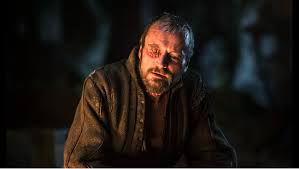
On an unrelated note, I tend to down at least a bottle of wine before each episode ends.  It's...don't question my methods, okay internet?
On an unrelated note, I tend to down at least a bottle
 of wine before each episode ends. It’s…
don’t question my methods, okay internet?
Anyway, with Tywin gone, the consequences for Westeros as a whole will probably be dire.  Cersei and Jaime are poised to be the primary movers in King’s Landing, but how long will House Lannister stand with their credit cards maxed out, their king and Hand murdered in quick succession in their very seats of power, and lacking the brainpower of Tywin, Tyrion or Varys to smooth things over?  With the Tyrells, Martells, Littlefingers, and eventually Baratheons scheming to depose them?

Is it 2015 yet? Oh, come on!

cast

Tuesday, June 10, 2014

GAME OF THRONES 4.09 - "WATCHERS ON THE WALL"

throne


“Watchers On The Wall” is set up to be Blackwater 2: Black Waterer.  And it’s a noble effort, but ultimately it can’t match the intensity of the show’s finest hour, even with Neil Marshal outdoing his own direction.  Castle Black, when you get down to brass tacks, simply lacks the depth of interesting characters that King’s Landing is packed with.  Also there is a more straightforward good guys vs bad guys dynamic at play here, whereas I imagine there were a good many people rooting for Stannis to take the throne, if only to remove Joffrey.  But what it lacks in the series trademark emotional complexity, it makes up for in spectacle and execution.

This is, handily, the best action the series has ever done, and it is delivered on a scale that dwarfs even the battles at Astapor (where the dragons and Unsullied tore through a handful of unarmed opponents) and Blackwater (which featured a clash of larger forces but basically confined it to small groups on one stretch of dirt).  It’s got a better sense of geography, of shifting tactics, and also a cathartic sense of paying off a storyline that has been slooooowly building for 4 years.  Plus it has giants riding mammoths and its big surprise tactic, the giant anchor sweeping the Wildlings off the Wall, is even cooler and more surprising than the Wildfire maneuver.

"Come men!  Follow my silky, voluminous curls to victory!!!"
“Come men! Follow my silky, voluminous curls TO VICTORY!!!”

Unfortunately, that sense of climax is undercut by the indecisiveness of the battle’s outcome.  I’ve talked before about how the show mines tension from not having a clear-cut “power rankings” (much as we like to amuse ourselves with them on the message board) so that we know going in that say, Ser Allister doesn’t stand a chance against Tormund or the head Thenn.  But the other thing that gives the periodic clashes between different characters or factions such a charge is that Martin is unflinching about providing them with definite winners and losers.  Sure, you have the occasional dust up like Jaime’s with Ned or Brienne that ends in a draw, but I’ve never had a sense that these skirmishes were being contrived to provide the audience with chances to see their fan favorites in action without committing to any real consequences.

This of course applies to more than just duels.  Just ask the Starks, or Greyjoys, or Martells, and they’ll tell you that the big overarching conflicts are just as susceptible to major, definitive swings of fortune as any individual swordfight.  Not that I don’t expect all of those families (with the possible exception of the Greyjoys – they’ve lost all the ground they gained in the second season and there’s still a fire leech out there with Balon’s name on it) to come back in some major ways, but it’s been clear for years that Martin doesn’t get bogged down trying to ensure that the primary conflicts remain at a familiar equilibrium, to better keep the audience oriented.  That’s a concern for a syndicated TV show, not so much a series of fantasy epics.  It also gives the series, for as slooooowly as some of its storylines can develop, a consistent sense of forward momentum.  Having source material, particularly one so ruthless with the audience’s desires, means that from the very first episode this series was going places.  Dany's storyline aside, I’ve never had a sense that certain characters or dynamics are being kept in stasis for the sake of padding out a 20-some episode season or to flatter the ego of a particular breakout star, as will happen with a traditional network series.

Or else we all know who would've been getting top billing the last 3 years
Or else we all know who would’ve been getting top billing the last 3 years

Which is all a roundabout way of getting back to the point that if “Watchers On The Wall” feels a little lightweight, it is because Game Of Thrones is generally not a show that ends its conflicts in a draw.  Take Stannis, for example. There’s no denying that his story has been frustratingly stalled since Blackwater, but that in turn allows Blackwater to still feel important in hindsight, despite the lack of major character deaths it produced – the defeat was significant, and not just for those people that prefer Stannis to the Lannisters.  The battle for Castle Black mainly functions at this point to serve up a second cliffhanger on top of last week’s (cruelly ignored altogether).  The Watch still holds the Wall, Mance’s army still hopelessly outnumbers them, and the only real development is that the marauders south of The Wall have been eliminated.  You could have replaced this whole battle with Jon leading another sortie against Tormund and the Thenns when they were camped outside Mole’s Town and end up in the exact same place, narratively.

"Before I die...tell me...(ack)...one time...how you get such bounce and volume from your bangs?"
“Before I die…tell me…(ack)…one time…
how your bangs maintain such bounce and volume?”
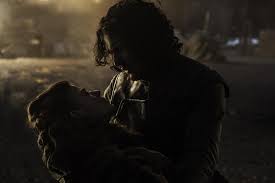
That being said, the battle does deliver on the fantasy spectacle level, and result in some surprisingly effective character deaths.  Ygritte dies in Jon’s arms, in a moment that was nicely acted but had been such a foregone conclusion for so long that I didn’t get too misty over it.  On the other hand, I was surprisingly moved by poor Pip’s bloody death, and Grenn going out like an ABSOLUTE BOSS.  I know some people are disappointed that we didn’t see more of the actual fight with the giant, but I wouldn’t change a single thing about how that was presented.  We didn’t know those guys all that well, but they’ve been familiar long enough that their deaths managed to resonate.

There were also good character and action bits to spare.  Thorne acknowledging (without apologizing) that he was wrong about the tunnel, then proving himself to be a legit badass rather than the Dwayne T. Johnson (edit:  Robinson.  Oof.  Geek credentials revoked) of Westeros.  Tormund’s restless, grunting berserker rage (I swear, Kristofer Hivju looked more feral than Ghost as he relentlessly prowled the castle).  The swooping, 360 degree shot of the carnage within the walls.  The absurdly awesome giant arrow sending some poor bastard halfway to the moon before crashing down into the courtyard.  Sam’s quickdraw on the crossbow (and even better, his delivery of “is it over, then?” to Pip).  Jon embedding a hammer in the main cannibal’s skull.

Early frontrunner for the 2014 "Image Most Likely To Provoke A Led Zeppelin Reunion" Emmy
And did I mention FUCKING GIANTS RIDING GODDAMN MAMMOTHS?
 The only thing the battle was missing was Tyri-…..ohshitohshitohshit, guys, I just remembered what happened with Tyrion and Oberyn last week! Oh fuckme, they’re gonna kill him I just know it I know it ah fuck fuckfuckfuck…..

val

Is it Sunday yet? Oh, come on!

cast

Thursday, June 5, 2014

GAME OF THRONES 4.08 - "THE MOUNTAIN AND THE VIPER"

throne

Sorry about the hold up, folks.  I’m out of the country this week, and it took me a couple days to find a way to watch the episode on an iffy internet connection.  It also means no pictures and probably more typos this week.  I know, I know, life on the internet is almost as harsh as it is in Westeros.  At least the episode wasn’t the least bit eventful or anything.

So things had been going good for too long in Westeros. This is a relative measure, obviously, as there has been slaughter and mutilation to spare throughout this 4th season, but we also hadn’t seen the death of really sympathetic character since the Red Wedding.  I’ve talked previously about how an inordinate amount of the damage this year was being taken by the outright heels (Joffrey, the slave masters, Arya’s tormentors, crazy aunt Lysa, the Watch mutineers, hell, you can go ahead and throw the grimy faux-Bonham Carter whore that menaces Gilly in there too), and expressed trepidation about things swinging back against the “good guys” before too long.  And with the closing sequence of “The Mountain And The Viper”, that pendulum shifts sharply.

But first there are other goings on in the world.  In Essos, Dany finally learns of Jorah’s previous occupation spying on her, and reacts poorly.  She notes that it was his reporting about her pregnancy that prompted the Westerosi’s assassination attempt, but ignores his protests that he also foiled the attempt – and has risked his life for her many times over since. She had to react somehow, but losing Jorah is more of a blow than I think she realizes.  She may not need his swordarm with Daario and Selmy and Grey Worm knocking about, but none of those guys seem interested in tempering her fiery-er instincts, as has already become necessary to rule even a single city.  Oddly enough, I am heartened by this turn of events; I had been thinking that Jorah’s increasing redundancy in the khaleesi’s service and generally likeable nature spelled doom for him all season, but I enjoy Ian Glenn’s performance so much that I’m glad that he will be spinning off into another part of the narrative instead of leaving it in a bloody mist of head trauma.

But we’re not there yet.  In other parts, Gilly and Sam Jr. also get a reprieve from what seems like certain death at the hands of the marauding Wildlings.  Good thing Ygritte is an ol’ softy (we’ll ignore for the moment the four other people she murdered in the sequence).  The rest of the Wall stuff is just the guys reacting to the attack.  I’m sure there will be a lot more to say about this story after next week’s coming Wallstravaganza, so let’s  just move on to the Boltons.

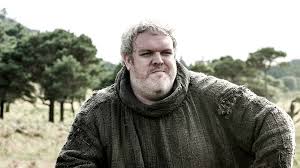
Theon’s life of misery continues apace, as he’s forced to impersonate (I guess?) himself to help the Boltons reclaim a muddy castle that will solidify their hold on the North.  Names were prominent this week, with Ramsay getting his father’s bestowed upon him at last, a new name to match the one he took from Theon.  This is bad news for those of us who find the relentless sadism of his scenes wearying, but at least it means that there will be a really hiss-worthy villain waiting for Bran Stark to root out of Winterfell when he and Hodor return triumphantly riding a mastodon or whatever.

Or perhaps his sister will beat him to the punch.  Sansa makes major strides towards becoming a legitimate political power this week, reclaiming her own name so she can pull Littlefinger from the fire.  Her reasoning seems simple enough, as he is the devil she knows, but it’s unclear just how deep she’s thrown in with him.  Did she give him “what he wants” after that cutaway?  Does she know exactly what the plan is for little Lord Arryn?  All of a sudden Lady Stark has secrets from us as the audience, and I’m more intrigued by her than I’ve ever been.

Something else occurred to me as she was descending the steps of the Eyrie, looking regal and sinister in a way we’ve never seen.  We’ve talked about Arya cycling through various tutors in the deadly arts, learning to survive the storm of swords that has covered Westeros, but Sansa has been going through her own education, as people like Cersei, Olenna, Tyrion, and now Littlefinger show her, sometimes unwittingly, how to play the game of thrones.  Oddly enough, the Stark girls now seem poised to grow into the positions of their hated enemies, the Lannisters – Arya is becoming Jaime, a deadly, charismatic killer with little interest in the titles and ruling that come with her name, while Sansa is poised to be the next Cersei, an ostensible trophy wife who is ruthless in leveraging her beauty and family name to get what she wants.

But that’s in the future.  This week, the main even is, obviously, the trial by combat that ends as brutally as it possibly could for all parties, including us viewers.  I should’ve known Oberyn was doomed from the moment I named him as a new favorite character a few weeks back.  I’m sorry to see him go, as Pedro Pascal’s performance was a real live wire, bringing an intelligence to the portrayal that tempered both his righteousness and hedonism into something that felt lived in and real, instead of simplistic, inconsistent notes.  But note that what gets him killed is his insistence on hearing the Mountain name names – both his sister’s and Tywin Lannister’s.

His death is brutal physically, but also emotionally, because it dooms Tyrion along with him.  As ever, Tyrion’s fate is sealed because even his champion puts him second to his real objective.  The Imp is a second son to the last.  And one of the more interesting facets of “The Mountain And The Viper” is how it addresses the grimness of the GOT universe head-on. Tyrion and Jaime, after musing over how many different forms of homicide have names of their own (except murder of a cousin, as cousin-killer Jaime notes), remember another cousin with highly allegorical brain damage.  Beetles or people, why do we return to watch them get ground so relentlessly to dust?  Are we foolish to think there is a point to be mined from witnessing such nonstop misery?  Is it enough to cheer the donkey when it randomly kicks the life out of the crusher?

It’s not just Tyrion who has noticed the harshness of this world; just look at all the people that use that phrasing within the episode.  Littlefinger: “My lady was not meant for a world as brutal as ours.”  Illyria: “Don’t leave me alone in this world.” Ranger Who Looks Kind Of Like Bronn: “When I’m done with this world, I don’t want to come back.”  Or just note Arya’s (perfect) black laugh at the news of her aunt’s death.  These people know that this world is unforgiving, and that there are far more beetles in it than there are crushers.  How they handle that knowledge is one of the more interesting aspects of human nature to examine, in my opinion, and that is part of the appeal of a dark series such as this.

Or maybe I’m just a perverse simpleton who can’t look away from a pair of naked breasts or a skull being popped like a grape, no matter how much I liked the guy it was attached to.  Either way, it looks like there will be more crushings on the way next week when the Wildlings finally reach the Wall.

Is it Sunday yet? Oh, come on!

 cast

Tuesday, May 20, 2014

GAME OF THRONES 4.07 - "MOCKINGBIRD"

thrones

“Mockingbird” begins with Tyrion casting about for a champion, and as many of us anticipated, he winds up with Oberyn as a volunteer once Cersei chooses the Mountain.  This is of course only after Jaime turns out to be both unwilling and unable to stand for him, and Bronn has been bought off for a price beyond what the dwarf can hope to match.  And even if he could, well…I still don’t think Bronn would fight against his pal for any price, but if the choice is between a pile of gold for taking a suicide run at the biggest, strongest killer on the continent and the same size pile for simply agreeing not to do any of that, then those scales are not exactly square, are they?

Speaking of the Mountain, this is, I believe, the third actor who has portrayed the brute. It hardly matters, as he’s never been called upon to be more than a hulking physical presence. The new guy certainly delivers on that score, and really, despite a lack of screentime, Ser Gregor Clegane has cast an appropriately-large shadow over the proceedings for years now. In addition to battling Robb Stark and killing Berric Dondarion off-screen for a season or two, his brutality in the sacking of King’s Landing and before has been a major force that has sharpened if not entirely driven Oberyn, Viserys and Dany’s desire for revenge. And as we are reminded this week, it was his abuse that made our favorite Hound who he is.

Which is to say, dapper. As. Fuck.
And the Hound is also a butcher, although he is more capable than his brother of turning his proclivities to merciful ends, as his treatment of the dying farmer (who apparently cultivates fields of figurative thematic dialogue) and protective turns toward the Stark girls have shown.  He’s not a big cuddle-bunny inside or anything, even after we see him practically blubbering about childhood toys, but that’s what keeps him interesting even as he stays bogged in a period-rendition of Curly Sue with Arya.  Of course, it also helps that Arya remains awesome, and is learning to be a proper seamstress with her Needle.  I had high hopes that she would make her way to Braavos to get some more dancing lessons, but at the rate she’s mowing through the more unremitting shitbags on the show, it’s starting to feel like she doesn’t even need them.

Speaking of shitbags, I’ve been generally for the show’s use of one-dimensional villain types on the peripherary, as they can still work as effective foils for the “heroes” even as it makes the larger point that none of them are wholly virtuous when you get down to it.  But there are moments when it goes too far, like when we have to wallow in Ramsay Snow’s sadism for episodes on end, or the master in Astapor whose entire personality seemed to be an elaborate, multi-faceted plea to be viciously murdered.  Another one I’m having trouble getting behind is Commander Thorne’s complete dismissal of the threat posed to Castle Black by an army of 100 freaking thousand men.  I understand that a theme of the show is how the Game makes people so eager to ignore the major apocalyptic threats around the corner.  But this problem is at his door already, and he doesn’t seem to doubt the size of the army (which more people than Jon can attest to), but does seem to think that a roughly 1,000-1 disadvantage is no cause for alarm.  And somehow the other commanders of the Watch seem to agree with him.  I could use some context for what these people think/hope will happen when Mance’s army hits the Wall, but none has been forthcoming thus far.

"The least believable thing about me is that William Atherton wasn't available to play me."
“The least believable thing about me is that 
William Atherton wasn’t available to play me.”
Now, what I expect to happen (not that Thorne possibly could), is that as the Night’s Watch is worn down to a barest nub, one Stannis Q. Baratheon will come charging in with the army he tricked the Iron Bank into funding by saying it was for the Lannisters. And it will be, eventually, in his mind, but the end of last season promised too much about his investment on this front – including “a great battle in the snow” – for it to have completely dropped from his radar now. Thinking about the titles that were listed so repetitiously last week, my guess is that Stannis has decided that before he can become King of the Andals and the First Men, he will have to first become the legitimate Protector of the Realm. Unfortunately, it seems that he has more hardship to endure before he gets there, as Melisandre/the Lord Of Light has some nefarious plan for his young daughter. I really don’t want to see a little girl sacrificed in some sort of heathen blood ritual; however, I am eager enough for this storyline to move past portents and pacing that I’d actually like it to happen sooner rather than later, if it must.

Meanwhile, in Mereen, Dany wears the living hell out of some blue dresses and screws Daario.

Shocker, that
Shocker, that
In slightly more eventful news, Hot Pie bores Pod and Brienne with the intricacies of kidney pie construction, which leads to their discovery that Arya is alive. I hope Brienne finds the younger Stark girl before the elder, as I think she would be a good mentor/protector figure for the girl after the Hound, but they’re all on the way to the Eyrie so maybe there can be one big happy family reunion, give or take one constantly raving, frequently lactating aunt.

I think most of us saw Littlefinger’s offing of Lysa coming; his ultimate designs for Sansa have been about the only clear thing about his motivations since the first season.  And while the girl is no doubt horrified by the awkwardly CGi-ed plummet of her “last” living relative, she may ultimately be relieved that this is probably going to spare her from another engagement to Joffrey 2.0 in Robyn, who makes up in petulance what he lacks in sadistic inventiveness.  The Moon Door is the solution to every problem for the young Lord of the Vale, who is basically the medieval version of that weird homeschooled kid, except with an army of knights at his command.

arryn

Or are they now at Littlefinger’s command?  Varys did predict that it would not be long before he had an army to go with his gold and titles, in the conversation that accidentally prompted Olenna to conspire with him to kill Joffrey.  And it would seem he is on the verge of revealing himself to be, as the Spider has long believed, the most dangerous men in Westeros. That is, if he can avoid following his wife out the Moon Door for a bit longer. And hey, it’s not like that scene from last week where Robyn played with the little mockingbird trinket for a minute before getting bored and tossing it out on a whim could be read as foreshadowing anything, right?

But all that intrigue and sexing can wait.  For we have bread and circuses coming our way first, in the form of a Viper vs. the Mountain showdown.  Oberyn may have told Tyrion a story that suggests that no one is really monster when you get to see them up close, but he now has to face off with the closest thing the show has to an actual ogre, at least on this side of the Wall.  And I expect him to triumph, not so much (as I got into last week) because I think Oberyn is a self-evidently bigger badass, but because I don’t think the show would have spent as much time on him if he was going to be swept off the board without impacting the narrative in a more profound way.  And since it would doom Tyrion in the process, I think their cumulative character weight is so much greater than a Mountain’s worth that the outcome is pretty much predetermined.  Right?  Right?  Please tell me I’m right (unless you’ve read the books; then please tell me absolutely nothing).  Because the bit about the Hound refusing to cauterize his wound does remind me that this is a show that once spent a season building up Khal Drogo as this ultimate badass only to have him just get randomly sick and die.  For a series that prides itself on making such borderline perverse storytelling decisions, I know I shouldn’t make such predictions with any sort of confidence.  I guess I’ll just have to wait and see…
Is it next week yet? Wait, 2 weeks? Oh, come the living fuck on!


Let’s pass some of that time gap reminiscing about some of the old pals we haven’t seen in ages.
Remember Gendry the bastard?

"It wasn't chicken."
“That wasn’t chicken.”

The Blackfish?
Still looking for a tree to piss on
Stupid Edmure?

"Bro, what did you want from me?  She was totally hawt, bro."
“Bro, what did you want from me? She was totally hawt, bro.”
Mance Rayder?

"No, I totally thought I'd be a bigger deal too."
“No, I totally thought I’d be a bigger deal too.”

Papa Greyjoy?

"THEY DID WHAT TO MS. NORRIS??"
“THEY DID WHAT TO MS. NORRIS??”
Jaqen H’Ghar?

"H'Ghar" is High Valyrian for "I'm not gay, but..."
TRIVIA:  “H’Ghar” is High Valyrian for “I’m not gay, but…”
Greatjon Umber?

"Oh bullshit you remembered me."
“Oh bullshit you remembered me.”
 
Thoros and the Brotherhood?

"No?  It's cool, it's not like I shattered the barrier between life and death or anything."
“No? It’s cool, it’s not like I shattered the veil between life and death or anything.”
Uncle Benjen?
benjen

Osha and Rickon (and Shaggy Dog)?

"Yeah, I was pretty awesome."
“Yeah, I was pretty awesome.”


"Yeah, I was a runny nose on legs."
“Yeah, I was a runny nose on legs.”
We miss you all!  Except Rickon.

Tuesday, May 13, 2014

GAME OF THRONES 4.06 - "THE LAWS OF GODS AND MEN"

thrones


“The Laws Of Gods And Men” was a tight, by relative GoT standards, episode that only found time for checking in on a scant 4 plotlines in total.  Noticeably absent from the entire affair was any sight of Arya, Bran, Sansa or Jon Snow – any of the remaining Starks, emblematic among all the houses for being most concerned with traditional concepts of justice and fair play.  It makes sense that this season, which finds the Starks’ influence at its absolute wane, is shaping up to be the most concerned with the difficulty of serving justice in a world ruled so much by intractable class systems and the whims of those who, by way of bloodline or swordpoint, find themselves in power.  Remember that the whole season started with a pre-credits sequence, which had been previously reserved for teasing the White Walker menace that will presumably dictate the entire series’ endgame, depicting Tywin Lannister destroying the blade that stupid, honorable Ned Stark used to dispense harsh but honest justice in the North.  The sword was described as impractically large, and while that is true, that is because its primary function was as a symbol of a concept that by its nature must transcend practicality.  So of course Tywin had it dismantled and refashioned into smaller, more effective weapons.  He is nothing if not a relentlessly pragmatic thinker.

That and a snazzy dresser
Practicality is also the ruling concern for the bankers of Braavos, which we finally see in its impressively-CGI’ed glory here. In the first of several tribunals shown presiding over the fates of characters, Mycroft Holmes himself extolls the virtues of hard numbers over more mutable words.  Stannis has a lofty claim to rule a country, but doesn’t have the numbers to back it up.  It takes some quick thinking on Davos’s part to reframe his “king’s” inherent nobility/hard-headedness as an asset to the Iron Bank.  After first running down the future prospects of the Lannisters (even he has to admit that Tywin will keep things locked down pretty well for as long as he’s around), he presents Stannis as the ideal client for a money lender.  Mycroft and co. may be quick to dismiss considerations of justice when deciding who to bet on, but the fact that Stannis does makes him a more attractive horse.  After all, what does a banker dream of, if not borrowers that are honest to a self-destructive fault?

The answer, of course, is nothing. They sleep like 
goddamn babies, on a pillow made of overdraft
 fees, every one of them, every night.
We also, finally!, check in with Yara’s efforts to exact some justice for her brother’s torture and mutilation.  Being Ironborn, her plan is to take it by brute force, rather than through appeals to any higher power or sense of honor.  And she carves a quick, bloody path to him, only to find that the physical damage pales in comparison to the mental scars.  While flanked by two remaining soldiers, her own tribunal that fails to deliver the justice she desired (too much of a stretch?  yeah, probably too much), she is forced to conclude that there is no putting Theon together again, and flee from the unhinged Ramsey Snow.  I still don’t entirely buy Ramsey as a person, but as a one-dimensional villain, his flamboyance certainly stands out on a show that is so devoted to ethical ambiguity.  That he reacts to his castle being invaded in the middle of the night with delight for the diversion is unsettingly effective.  His scenes with Theon still feel more drawn out and sadistic than is necessary to get their point across, however.

In Mereen, with Jorah and Selmy completing her own judgmental trio on the dais, Dany begins to learn that doing what queens do is easier said than…do.  In actuality, it involves attempting to determine how to punish wrongdoing without endlessly perpetuating a cycle of retribution and suffering.  It wasn’t really a question that she would let the nobleman bury his father, as she has every reason in the world to emphathize with the children of the coup d’etat-ed, but one also wonders how long she can afford to pay triple for the damage done by her dragons.  The dragons that represent her power and legacy, but are also forces of nature.  They are uncomprehending and indifferent to any talk of rights or justice, and I did notice that while there are three of them, only one was represented in scene where the goat was flambéed.

"The Mother Of Dragons officially declares this visual motif stretched beyond its breaking point.  Further pretension will be answered with crucifixion."
“Her Grace officially declares this visual motif stretched
 beyond its breaking point.  Any further pretension 
will be answered with crucifixion.”
Right, so Dany’s quest may be stalled out in Mereen for the moment, but she is attracting more interest in King’s Landing than ever.  The Small Council scenes, for all their constantly shifting roster, have been for my money the most unwaveringly entertaining aspect of the series.  Even after losing Tyrion and adding the empty, unctuous gasbag Mace Tyrell (who sort of doubles up on that suck-up dynamic when sitting next to the deflated, unctuous gasbag Pycelle), the Council manages to remain great by introducing Oberyn into the mix.   While Tyrion offered a sardonic running commentary to these scenes, Oberyn’s heckling has a more arrogant, antagonistic bent that freshens up the dynamic and avoids having them become airless affairs where everyone nods along with Tywin.  And while the lords of Westeros are still underestimating the size and danger of her dragons, it will be interesting to see how they intend to sabotage her camp from afar.  One presumes they’ll start by informing the khaleesi that her top general used to spy on her for them.

But the Council scenes, and also the similarly great one between Oberyn and Varys, are just preambles to the main event of Tyrion’s trial.  There is much greatness here, and the show wisely allots the time to spend the last half of the episode just luxuriating in the performances.  I figure anyone reading this is likely to also be familiar with Alan Sepinwall over at Hitfix. He’s a great critic, but his common refrain for at least the last couple seasons now has been that GoT’s storytelling is too diffuse, and only reaches its full potential when it hunkers down in one place and tells an extended, focused chunk of story, like in the Blackwater and Red/Purple Wedding episodes.  And while I agree that those parts do represent the high points of the show, I do think (with all due respect, as I regularly read and enjoy his work) he’s wrong to want the show to be that thing all the time.
It’s like this: a block down the street from where I’m sitting is Shaw’s Crab House.  Great stuff there, and when I can afford it I will splurge on a lobster dinner.  Now, the lobster is without question the highlight, but that doesn’t mean the experience as a whole would be improved if they switched the salad to another portion of lobster, and the sides to another portion of lobster, and the dessert, and the wine.  That’s not a meal, it’s a pile of sea monster guts.

Buttery, delicious sea monster guts.
Buttery, delicious sea monster guts

These episodes where various storylines and characters converge only stand out because they are exceptions to the show’s rule.  They’re payoffs, whether they come at the climax of a season or not, and payoffs require a set up to work.  And they are even more satisfying when they can tie together really disparate threads; a very big part of what makes Game Of Thrones’s storytelling so satisfying is that it has the ambition to tell its tale on such an insanely-broad canvas, without forgetting that this allows for the highest drama to occur when the action collapses down to a single focal point. But you can’t collapse without first sprawling.

The reason I support the show’s sprawl is that it engenders not just thrilling climaxes, but the sense of unpredictability that I constantly cite as the series’s greatest strength.  With such a wide canvas, we don’t even know (outside of what hints the credits sequence provide to those of us that pore over it each week) what characters we’ll be seeing, or in what context.  If the show were to fall into a steadier, more “focused” back-and-forth structure between storylines, where I knew that one week being a Dany/Theon/Bran/Littlefinger week meant the next would be a Jon Snow/Stannis/Arya/Lannister week, then I would at least subconsciously have a better idea of what to expect as I sat down.  Same if I knew that a character appearing in one scene guaranteed a certain amount of time with that storyline for the episode.  It doesn’t have to be specific details to get me to lean back in my seat a bit.

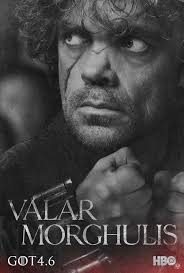
Anyway, the point of this tangent is certainly not that Sepinwall or those that agree with his take (which many do) are dummies, because the trial sequence is stronger for allowing us to stay in the moment with Tyrion for so long.  Really, the whole thing probably treads too closely to what we saw at the Eyrie in Season 1, right down to the fake-out confession before demanding trial by combat. But it’s brought off by the radical difference in the intensity of Dinklage’s performance, and the novelty of seeing pretty much everyone that Tyrion has had a meaningful interaction with throughout the series, sans Bronn, show up to damn him from the witness box.


Pictured: Radical Intensity
It’s remarkable how little lying they have to do in order to completely condemn him; the only falsehood that any witness tells the Court is Cersei’s whitewashing Joffrey’s cowardice from her account of the Battle of Blackwater. Until Shae takes the stand, at least.  And this threw me for a loop, I’ll admit.  Sibel Kekilli has never been among the top tier of performers on the show, so I’m not sure if the performance was unintentionally opaque or I am just an idiot or what, but it seemed a stretch for her character to return on her own to do this solely out of spite.  I know she was genuinely hurt by being sent away and hell hath no fury and all, but if she wanted to see him dead, that could’ve been accomplished by…doing nothing.  And not exposing herself to the vicissitudes of the Lannisters in the process, which she was given every right to fear.  But I can’t figure an angle she could be playing where thinking that testifying against Tyrion would help him, even if she knew that a guilty verdict would not result in beheading.  So I’m currently assuming that she was coerced, but didn’t resist too hard because it allows her to exorcise some real anger while she’s up there.  And hey, book readers? I’m not looking for clarification in the comments, please and thank you.  I’ll find out in a week or so.

But anyway, man, how about Dinklage’s performance when Tyrion’s had enough of his judges pretending they are seeking justice, and not simply the “truth” that best supports their interests?  And how will this play out?  Is he allowed a champion, like at the Eyrie?  If so, will Jaime fight for his brother or the Kingsguard?  Will Tywin allow Bronn to serve?  If the Mountain arrives to serve as the representative of the Lannisters, will Oberyn be able to resist volunteering on the Imp’s behalf?

Is it next week yet? Oh, come on!!