Monday, April 29, 2013

WHAT THE F%#& IS WRONG WITH THE FOLLOWING?

(This piece was originally published on Chud.com)

Here’s what you need to know:  Fox’s The Following follows Kevin Bacon as retired FBI agent Ryan Hardy, called back to duty to pursue escaped (more than once) serial killer James Purefoy, and his cadre of homicidal followers who have formed a cult based around the writings of Edgar Allen Poe (sorta).

Also, it’s terrible.  In almost every conceivable way.  But punishment gluttons Al Schwartz and Justin Waddell have been unable to miss a single episode of this ongoing creative trainwreck/ratings hit.  Whilst steeling ourselves for tonight’s STUNNING SEASON FINALE, we decided to make like Laura Dern in Jurassic Park and sift through the mound to try to determine where this ship went off course and if there is any hope of righting it.

 "Did he tell you about his Deathcurse?" - EVEN MORE ACTUAL DIALOGUE FROM SHOW
 “Did he tell you about his Deathcurse?”
- ACTUAL DIALOGUE FROM SHOW

AL:  Let’s start with Ryan Hardy.  He’s our hero, and I hate him more than a little bit.  He’s not charming, he’s not funny, he’s not empathetic with either victims or co-workers, he’s not actually good at his job (like, at all), but somehow acts like that’s everyone else’s fault.  Because it’s not like FBI bureaucracy has screwed up any of his great plans for catching Joe; it’s his chronic inability to take backup with him that has caused most of the trainwrecks that have ensued any time he steps out of the computer room.
 
We all like Kevin Bacon.  But the season is basically over; shouldn’t the protagonist have displayed some sort of sympathetic trait by now?

JUSTIN:  Kevin Bacon is a picky actor – at least it seems that way. If you look at his filmography, he seems like somene who has really thought deeply about the roles he takes.  So, I imagine, it must be hell to be stuck in the role of Ryan Hardy.  It’s an awful show, for sure.  But it also hasn’t given Bacon much to do other than be overconfident for no reason and grab a bottle every now and again to remind us that he has a drinking problem.  Oh, and to breathe hard every once in a while to remind us that he has a damaged heart. 
 
Leading into the final, it’s hard to understand anything presented by the show.  You have to just accept that Joe Carroll has a mysterious hold over people.  We haven’t seen how he is effortlessly able to brainwash his loyal subjects.  In place of a grand plan, he sacrifices (and some times just plain kills) these folks in the pursuit of annoying Hardy or having a romantic dinner with his ex-wife.  Finally, in the penultimate show, there was a character that wondered what it all meant (the confoundingly sympathetic Jacob Wells).  But he was responding to the danger of the Carroll’s plan, not the actual plan – which he seemed cool enough with.  Anyway, he is inevitably dispatched.  So, not to worry, the Carroll ranks have been righted!  So, where does this leave us?  With Carroll on a boat with his ex-wife and one of Hardy’s partners (cult expert/idiot Debra Parker) buried alive in coffin.  Both of these women could potentially be saved, but would stand a better chance if Hardy’s crew wasn’t so unable to understand the idea of not going off alone in the pursuit of could-be-anybody, suicidally-fanatical bad guys.
 
 "He's speaking to people through Gothic Romanticism!" - ACTUAL DIALOGUE FROM THE SHOW
“He’s speaking to people through Gothic Romanticism!” 
– ACTUAL DIALOGUE FROM THE SHOW

AL;  You’ve hit on my biggest issue: there is absolutely no character with whom I sympathize.  Ryan is unambiguously our hero, but he has that tremendously unappealing blend of being kind of pathetic and kind of cocky about it.  Even Bacon can’t rise above it.  So who else might I want to spend time with?  The show serves up several options, each complete with an insurmountable barrier to empathy that the plot and the ludicrous premise demand.
 
Early on, I occasionally felt bad for Claire, which was largely a residual of completely falling in love with Natalie Zea on Justified.  And she should be a sympathetic hero in most respects, as she is a victim of circumstance and has proven tough and fierce enough to avoid being an utterly typical damsel in distress.  The problem is, she is constantly making decisions that, while not nearly the dumbest thing in a given episode, are simply not ones that we would make in her position.  She ditches her FBI protection to volunteer to be the cultists hostage after she has escaped from having ditched her FBI protection and volunteered to be the cultist’s hostage.  She keeps stabbing Joe, but apparently just because she likes how it feels, because she won’t finish the job.  Plus she’s in love with Ryan, who sucks at everything, and married Joe, who was a smarmy douchebag on a good day, when he was hiding that he was actually Jack The Ripper.
 
And let’s have a hand for the Following Bureau of Investigation.  They may not accomplish much, but they sure try their hardest, don’t they?  Honestly, the presentation of law enforcement on this show feels like someone trying to make a gritty drama based on this classic Onion article.  They are epically, tragically inept at every turn.  Recent events have shone a harsh light on just how fucking ridiculous it is that the world’s most famous serial killer has broken out of jail twice in a matter of weeks (once in a helicopter), and that the Feds can’t find three agents to rub together for a raid no matter how many people get murdered on national TV.  There was a sting on a 10th grade pot dealer in Little Rock last week with more manpower devoted to it than Bacon’s foray into the cult’s paramilitary militia training facility.  But of course, they have to be incompetent, because they have the combined resources of the federal government of the world’s greatest superpower behind them, and the cult has kitchen knives and a few copies of  The Purloined Letter.  We are instinctively drawn to people who are good at their jobs, and want to root for the underdog.  This premise will not allow for the good guys to be either.
 
Finally, we have the cultists themselves, and the show’s baffling request that we invest in their romantic and interpersonal entanglements.  They are definitely the underdogs in this situation, as it is literally them against the world, and as the characters in the tightest corners, they could potentially have the wildest problems to deal with.  But there is just the little issue that EVERY SINGLE ONE OF THEM JOINED UP FOR THE EXPRESS PUPOSE OF  TORTURING AND KILLING INNOCENT PEOPLE FOR KICKS.   Including Jacob, the “sympathetic” one. 
 
 "Is that negotiator-talk?  It won't work, lady!"  - ACTUAL DIALOGUE
 “Is that negotiator-talk? It won’t work, lady!” 
– MORE ACTUAL DIALOGUE FROM THE SHOW
 
JUSTIN:  I guess I like Claire. You almost have to feel for her a little because she’s 2 for 2 in the don’t date that guy department. She’s focused on getting her son back, and no one is helping her accomplish that task, so you have to forgive her for her crazy gambles.  The FBI certainly can’t protect her.  After years of no communication, Hardy is trying to half-patch things up WHILE her son is kidnapped.  After trying to make sense of the law enforcement side of the show, the cult has to look somewhat normal to her.  Who else?  Cult expert Debra Parker has an interesting background that ties into the show.  But they’ve done nothing with it.  I like the actress though.  Shrugs. 
 
Anyway, the show can’t really make any character compelling.  They want you to sort of care about the main individual cult members….but, like you said, they are super weird and crazy murderers.  They only reason I imagine that they focus on side characters so much is that Kevin Bacon, before he signed on to the show, put it in his contract that he didn’t want to appear in every scene. 
 
That’s my theory, at least. 
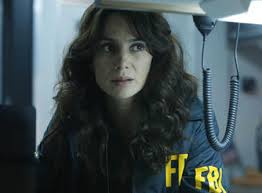
"He had a sense of honor about him.  Like he was living up to some code of conduct." ACTUAL DIALOGUE FROM THE SHOW 
“He had a sense of honor about him. Like he was living up to some code of conduct.”
– STILL ACTUAL DIALOGUE FROM THE SHOW 
 
It is (somehow) going to get a season two, so it will be interesting to see what problems the show’s staff attempt to resolve.  I don’t know if Joe Carroll and his countless minions will continue into season two or not, but the show would  certainly be better off burning everything to the ground and introducing a new threat.  They also really need to discover what makes Ryan Hardy a compelling character.  He is arrogant for no reason.  None.  He is constantly failing – and they don’t even make that interesting. His “death curse” theory comes across as nothing more than a woe is me complaint.  He needs to have a little success so we can believe him as a sharper-than-the-rest investigator. Rather than a disheveled dumbass whose main characteristic is that he doesn’t like authority.
 
There are critics that suspect that Kevin Williamson is using this show to not so subtly poke fun at the murderTV genre. I don’t believe it for a second. But I can see why people are throwing that excuse at the show. How else can you explain some of the dumb shit they throw in there?
[
AL:  The thing is, which explains most of the dumb shit and bodes ill for a second season surge in quality, is that this is a fundamentally broken foundation for an ongoing series.  This concept could maybe work as a 2 hour movie, where we followed Hardy and the FBI exclusively, allowing the paranoia of anyone possibly being a cultist to drive the tension. To fill runtime of a series, though, we have to spend some time with the cult, which is just awful.  We can’t sympathize with them, and seeing their inner workings just highlights the absurdity of the scenario on every level.  If we were only ever with Ryan while he received untraceable calls from Joe and killers popped up and disappeared, we could just marvel along with him (our identification character) at how they are managing to pull this off.  When we can see behind the curtain, that it’s just a house full of weirdo fucks with one IT guy, it diminishes their threat and makes us lose respect for the FBI in the process for not being able to counter them.  And it’s not like we have an abundance of respect for the FBI to start with.  Even our hero Captain Failure spends half his time sneering at how stupid they are.
 
The other thing about spending time with the killers is that it puts the onus on the writers to portray Joe as a legitimately compelling figure who could attract such a cult of personality.  And they are clearly not up to that task.  Joe’s characterization feels like a dumb person’s idea of a genius.  He’s running this impossibly elaborate operation, fueled by the blood of followers that volunteer for suicide just to be a small part of some dumb book they’ve never even glimpsed, and all he has to offer them for their service are shallow literary allusions and arbitrarily tortured sentence constructions

 "Claire was crafty with that bloody knife.  But I remain undaunted!" - STILL ACTUAL DIALOUGE
 “Claire was crafty with that bloody knife. But I remain undaunted!” 
–  TOTALLY ACTUAL DIALOGUE
 
In terms of fixing it, I don’t think there’s any way to do it.  You could completely change the characterization of both the hero and the villain, to make the former actually likeable and the latter actually threatening, but even that wouldn’t get you in the clear.  Would an embrace of camp help?  I don’t think so;  the only thing making this amusing now is how much conviction it has in its own stupidity.  If it’s still stupid and lacks conviction it will just be tedious instead of mind-boggling.  Can they replace Joe and introduce a new killer?  That might be the best option, but the title implies that we will be dealing with this cult for the duration.

JUSTIN:  Well, I think they can probably fix it. They have good actors, obviously.  And they have a seasoned writing staff that, it seems, is pinned down under an impossible premise.  I don’t know, maybe Kevin Williamson has a The Following book of rules that the writing staff is not allowed to break a commandment or else.  At least that’s how I like to imagine it.  I think one thing that would help the show is to have it comment on itself more.  The world of The Following is so crazy and so dumb, the characters – like the audience certainly does – need to call things out.  The absolute ineptness of the FBI needs to be addressed.  Joe needs to have some followers asking themselves why they are latched onto to someone who has no plan other than to have a candlelit dinner with his ex.  Hardy needs to actually be drunk at some point.  So far, he just looks like a guy that collects empty vodka bottles for laughs.  The show just needs to make fun of itself more.  Even once would be nice, actually.  The world that Williamson and his staff have created is so ridiculous (press conferences where Poe passages are read, for one) that the audience needs to know the creators are fully in on it.  
Beyond all that, I’d be really surprised if they killed Joe Carroll off in the finale.  And it maybe isn’t a good idea to kill him off. The character is not compelling.  But James Purefoy is a pretty decent actor.  And this show needs good actors to hang its bullshit on.  Like I said earlier, critics are guessing that Williamson is goofing on murder of the week shows.  He’s not.  But it would not be a bad idea to course correct and do just that.  Or, well, do ANYTHING other than what they are doing now.  Make Bacon the maniac next season.  Clone Claire.  Hire Peter Sarsgaard to play a crazed killer.  Oh, wait. That’s how they are patching up The Killing

AL:  What’s funny is that the show has a built in method of commenting on itself, with Joe’s big stupid book, but it doesn’t even register as such because everything around it is so insane and bad that it just feels like more of the same.
 
 "We didn't date!  We flogged each other." - EVEN MORE ACTUAL DIALOGUE FROM SHOW
“We didn’t date! We flogged each other.”
- EVEN MORE ACTUAL DIALOGUE

But in any case, I don’t agree with you here.  For me, the fact that it’s so po-faced about its own stupidity is a big part of what makes it (inadvertently) watchable.  I think we have more than enough genre pieces that aren’t actually good on their merits but also try to wink at the audience and force you to laugh with them instead of at them (which any 4th grader can tell you is not as fun).  You only get into so-bad-it’s-good territory when you’re genuinely trying to be good.  When you’re being bad but also sort of trying to be in on the joke, you’re Snakes On A Plane.  And nobody likes Snakes On A Plane.

The problem is definitely not the actors, or at least not the core cast.  It’s that this story is built in such a way that there is really only one twist in its arsenal, which it is forced to repeat ad nauseum, and the heroes have to be blitheringly incompetent in order to keep it going.    I thought maybe they could pull off some wild status quo change like having Claire get brainwashed into joining the cult or for Roderick to kill Joe and take over, but they’ve closed the door on those possibilities.  
 
Do you have a particular favorite quote from the show?  Or example of staggering FBI incompetence?  For me I think I have to go with “What the hell, man?  Were you beaten as a kid or something?  I was just looking for a new friend.  DAMN.”   Basically, any time one cult member asks another what’s wrong with them or why they’re acting this way, it’s gold.  Yes, Vince the Constitutional Extremist, you’re in the secret lair of the deathcult founded by the world’s most notorious serial killer.  I’m going to go ahead and say every single person here was either beaten as a child, or something.
 "Looks like I drank the Ryan Hardy Juice too." -  YES ACTUAL DIALOGUE AND NO THEY DIDN'T GET THE RIGHTS TO SAY "KOOL-AID" AND NO THERE WAS NO REWRITE
“Looks like I drank the Ryan Hardy Juice too.”
- YES ACTUAL DIALOGUE AND NO THEY DIDN’T HAVE 
THE RIGHTS TO SAY “KOOL-AID” AND NO THAT 
DID NOT WARRANT A REWRITE

JUSTIN:  The all time quote happened last episode. When Carroll was watching surveillance footage of Hardy having sex. After the deed, Hardy reaches for a bottle. And his lover (also a secret cult plant) suggests that his drinking habit will eventually kill him. 
 
Hardy, without missing a beat, says, “Can’t kill me. I’m already dead.” 
 
I mean, that’s just an awful line.  We already know that Hardy is depressed and self-obsessed.  So when he says shit like that, it’s just hilarious overkill. 
 
As far as the FBI’s stupidity, there are so many instances.  It’s a really strange show.  Joe’s cult is better organized, and have success after success.  Even when Hardy dispatches a member, even a key member, it doesn’t even upset their goal.  Well, to the extent that there is a goal .  But the FBI has produced nothing but consistent and hilarious failures in the pursuit of the escaped madman. 
 
Anyway, you say the book Joe is writing is commenting on the show.  I don’t buy that.  I think the creators just want to give Joe some kind of purpose.  He really has none. I think that it would have been interesting  – well, sort of – to see Joe Carroll’s army of loyal murderers wedded to some kind of insane, overarching evil plot.  But the writers don’t give us anything close to that. Joe’s is toying with Hardy.  He wants his family back . There are Poe masks and a now exposed training facility.  Every now and again he kills one of the cult members or asks one to kill themselves. But to what end?  Both Carroll and the writers don’t have much of a reason to even have a gaggle of psychos at the ready.  It’s like Williamson came up with a premise, sold it, and then figured out quickly that it didn’t work.  But, shit, scripts were due.
 
It’s actually not that fun to pick on this show. A show like The Walking Dead, which balances its weaknesses with strengths, is more interesting to pick apart. The Following doesn’t really do anything right, so I just kind of feel bad for it. I guess it’s a somewhat popular show. Maybe they will figure, “Hey, people are watching it. We don’t have to fix anything.” (The same attitude they have onThe Walking Dead, unfortunately.) And the second season will be just a continuation of the first. Ugh.
 
Anyway, at least Comedy Central renewed Nathan for You.  There is good renewal news out there, Al.  Joe Carroll can’t take that from me.  
   "I'm your past.  You need to look forward." "What if you are my forward?" FUCKS SAKE  
“I know you’re upset.”
“Yes, and I am processing those feelings through the therapy of words!”
- FUCKS SAKE
 
AL:  I wasn’t saying the book is really successful in commenting on the show, but that it’s a perfect device for it that is just sitting there, untapped.  Though I also understand why they’ve been dialing back the Poe stuff as the season goes on, as it’s the biggest dumb-person’s-idea-of-a-smart-person aspect of Joe’s character.  The more we see him as a fanboy in his own right, the less believable he is as a cult leader on his own.
 
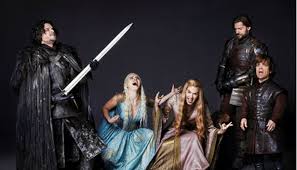
But ultimately, The Following is too successful, and also too unrelentingly ugly, nihilistic, and cynical in its violence for me to take pity upon it.  I am a great fan of violent TV; my favorite shows are Game Of Thrones and Breaking Bad, both of which have more disturbing and certainly more grisly sequencese, but which also treat those developments with a respect and gravity that The Following seems completely incapable of.  Here it’s all hollow, sensationalist depravity for no greater purpose than to try to goose the audience enough to stick around through another commercial break.  Everything that pearl-clutching scolds claim that violent TV is, in other words.  Even if comparing it to cable drama heavyweights like that is unfair, NBC is currently airing a new Hannibal Lecter show that manages to be more gory, more disturbing, and more thoughtful about the lasting effect of such acts than The Following, which loves to throw to commercial on Bacon agonizing over another murder laid at his feet only to come back with him ineffectually quipping along like before.  By the way, Hannibal is also gorgeously shot for a network show, in stark contrast to this show’s signature sequence, “Kevin Bacon chases and shoots cultists in a completely unlit tunnel/basement”.  I recommend it.

But while trotting out these comparisons, an idea struck me that may be the best route for change in the second year.  I was thinking of Sons of Anarchy, a show I quite enjoy for being hyper-violent without the meditative quality I ascribed to those others.  But there is a gleefulness to that show’s most bonkers sequences, when severed heads are popping up in chili pots or whatever, that The Following‘s dour tone suppresses.  So maybe what they should be shooting for is more pulp than camp.  The latter is a bit more self-aware, which I don’t think does this show many favors, but perhaps a bit more enthusiasm for what makes it such a special little turdflake would make things go down smoother. 
 
As it is, you’re right, almost anything would be better.  It’s a stupid, ugly, empty show that wastes the talent it has and gives serial killer porn a bad name.  So let’s just conclude with an agreement of how incredible The Claw Of Shame is.
 
 The Following season finale airs tonight at Who Cares Nathan For You Is Streaming On Comedy Central's Website O'Clock
 "Seriously, did he tell you about his Deathcurse?"


Monday, April 22, 2013

GAME OF THRONES 3.04 - "AND NOW HIS WATCH IS ENDED"

thrones

Lots of people were looking for retribution this week, and a few of them even got it.  Game Of Thrones is a series where it often seems like assholes thrive and in young Sansa’s words “the worst never die,” so getting to see some of the most unpleasant customers get what’s coming to them made for the best and most satisfying episode since “Blackwater”.

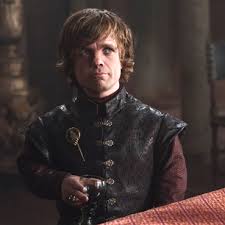
In King’s Landing, Tyrion seeks Varys’s help in pursuing revenge against his would-be killers, a pursuit that is complicated by his currently low standing and the fact that he couldn’t simply lay waste to his own family even if he had the means. Varys advises patience, providing as a handy visual aid the trussed up body of the sorcerer who castrated him as a boy, delivered to him in a crate for a heaping plate of very, very cold revenge.  Dinklage and Conleth Hill always play well off each other, but this is a particularly good scene, as we get some backstory that had been teased to  us for years and provides one of those rare opportunities to revel in a nasty customer (even if we didn’t know he existed prior to the scene) getting what’s coming to him.

But that’s not even Varys’s best scene of the night.  Diane Rigg absolutely dominates her screentime, delivering one of the most memorable lines of the series when she muses about what would happen when “the non-existent bumps against the decrepit” (Hill’s exaggerated, practically vaudevillian look to his own crotch at this is as amusing as it is ridiculous).  I also particularly liked the her dismissive acknowledgment that Sansa is not particularly interesting in her own right, but has led an interesting life.  It’s a spot on assessment, nicely meta without putting any strain on the fourth wall.

 varys
 “You mean I’m a eunuch? Wow, that really seems
 like something someone would have mentioned
 in every scene I’ve ever been in.”

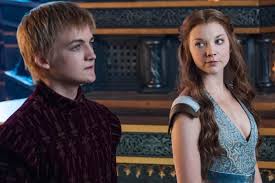
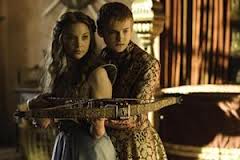
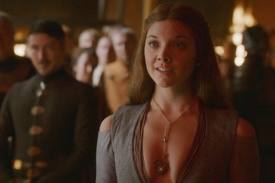
Oleana is the ultimate pragmatist, though, so she quickly gets on board with Varys’s plan to head off Littlefinger’s designs on Sansa, and the northern armies such a union would put within his grasp.  It falls to granddaughter Marge to seduce Sansa into agreeing to be her brother’s beard, which doesn’t seem likely to be the most fulfilling marriage for either party but has to be a step up from her current situation all the same.  But then seduction appears to be Marge’s primary mode of communication; if watching her put on the pretense of friendliness to Sansa is upsetting, watching her manipulate Joffrey is downright nauseating, as he regales her with giddy descriptions of the sadistic acts and ends of former royalty.  It gets even more unsettling when she convinces him to greet the crowd she has managed to turn (at least a bit) in his favor; as disgusting and dangerous as Joffrey is now, one shudders to imagine what he could do with even a speck of political acumen in his tiny, inbred skull.

 Well if it isn't 2/3 of the easiest Marry/F***/Kill round that could ever exist
 2/3 of the easiest Marry/F***/Kill round that could ever exist
 
Cersei is threatened enough by the Tyrell ascendance that she volunteers for her own round of “Charles Dance devastates your entire life and character without looking up from his letter writing” theater.  He is every bit as withering in his estimation of her as he was of Tyrion, telling her flat out “I don’t distrust you because you’re a woman, I distrust you because you are not as smart as you think you are,” and blaming her for not controlling Joffrey.  This prompts her to dare him to try to bring the kid to heel, which he tantalizingly promises he to do.  I don’t see this ending well for the old man, as Joffrey is too big an idiot to realize that how badly he needs people like his grandfather to prop him up.  But it should be great to watch.

Another Lannister contemplates revenge in Jaime’s storyline, where he is understandably distraught, as his swordhand was the only thing about him to which the world assigned any value outside of his name.  And going way back to the second episode of the series, he opined of Bran’s injuries that “even if he lives, the boy will be a cripple, a grotesque.  Give me a quick, clean death any day.”  He certainly had other reasons to believe Bran specifically was better off dead, but it seemed to be a genuinely held sentiment.  And there is nothing clean about the ongoing abuse he is receiving from his captors.

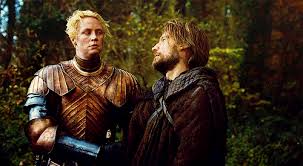
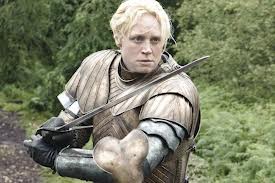
Jaime professes not to care about revenge, but I don’t think we’ll be stuck for long with a morose, resigned Kingslayer.  Brienne gives him a swift verbal kick in the seat, and while she may lack some of the oratory verve of Al Swearengen, the message seems to sink in.  These two are more bound together than ever, with her recognition that it was only his intervention that saved her from a nasty fate last episode.  It makes me really want to see what happens between them once they are inevitably freed from Locke and his men.

Oh, and what the fuck is going on with Pod?  Apparently he really does just have Magicwang.  This is too arbitrary a thing for the show to keep returning to for simple comic relief, but I can’t for the life of me figure out how it could possibly pay off.

Anyhow, back to REEEEEEEVENNNGE!!!  The Brotherhood Without Banners appear to be a band of merry men intent on making the noble houses of Westeros pay for the collateral damage their squabbling has caused.  Which is all well and good, and The Hound certainly deserves execution for the atrocities he’s committed in service to the Crown (including murdering Arya’s friend following her spat with Joffrey), even if the Brotherhood is mostly holding him responsible for things his brother did.  But they are also, we learn, devotees of Melisandre’s Lord of Light, which is disconcerting.  And does not bode well for Gendry, if they are connected to her, since she’s out looking for Baratheon blood.  But he’ll have some entertainment in the meantime, as the Brotherhood’s leader, an errant knight charged with bringing down the Mountain by Ned back in the first season, sentences the Hound to trial by combat against his own self, in what seems a thoroughly questionable decision.
 barric
 Trial by combat: deeply, resolutely fucking stupid as
 a system of justice, but where would our fantasy 
series/video games be without it?

Theon, meanwhile, isn’t even sure who is taking vengeance on him, but an emotional monologue from Alfie Allen indicates that he knows he deserves it on some level.  His storyline hasn’t amounted to much so far, to the point where it doesn’t seem like there was much reason not to just kill him off at the end of last season.  I think we can presume that the creepy janitor who freed him and recaptured him is Roose Bolton’s bastard, due to a lack of any other viable suspects, but there’s something very off about the whole situation all the same.  Did he really need to murder several of his own men to lull Theon into his confidence after he had freed him?  If he’s in charge, why does he seem to be hiding that from the other torturers?  Was he trying to get information about the Stark boys from Theon, or just messing with his head to make it even worse when he’s strapped back on the rack?  When are we going to get some more time with Yara anyway?

But if there is not enough progress with Theon, “And Now His Watch Is Ended” more than makes up for it with explosive developments on the two fronts that have always been the slowest-burning, the action across the sea and north of The Wall.  These are the types of developments that you expect to be seen in a season finale (and in fact, made me wonder if they could’ve been packed into last season, which saw very little forward motion in either plot), but there is something exhilarating about seeing them come less than halfway through a season that I know to be covering only one half of the source book.  If this is still the set-up…I can’t even imagine what the pay off will be.

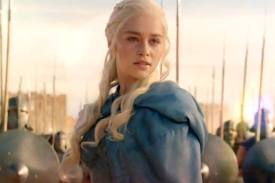
 dany
 Oh right, with the blood and the fire

This stuff is even more satisfying because, as mentioned earlier , it involves the comeuppance of two of the more one-dimensional black hats on the show. Sure, seeing the Night’s Watch tear itself apart is a bad development, but any sadness at seeing Lord Commander Mormont reach the end of his watch is counterbalanced by getting to see Craster the daughter-fucking, child-murdering shithead get stabbed right in his (shitty) head.  It will be interesting to see how Jon Snow’s undercover mission is affected when he learns of the mutiny.  Improvising doesn’t seem like a real strength of his, does it?

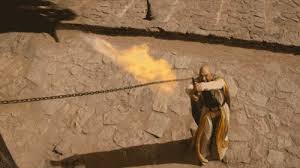
Finally, Dany does exactly what we all expected her to do, and immediately roasts Master Hostiledouche alive and frees the slaves of Astapor once he gave her uncontested dominion over an army of fearless, remorseless killers.  Well played, Hostiledouche, well played.

 kraz
 I believe the word you're looking for is "derp"


I kid, because being predictable doesn’t make the sequence any less awesome.  Dany is well on her way to crashing the party in Westeros, and we’re only 4 episodes into the season.  I’m sure there will be some speed bumps in her way that will prevent her from making landfall until at least the season finale, but damn if this episode didn’t get the blood pumping and leave me reeling heading into the closing credits.  Not that any particular plot point happened, but that it was all happening so quickly.  With so many shows that can be described as “slow burning”, the pace is a result of not having a firm enough grasp on their own mythology and longterm plans to know when it’s safe to move things forward.  That’s not an issue with Thrones (one of the benefits of having strong source material in place), so it can burn as slowly as it wants before exploding multiple storylines in a single episode.


Is it Sunday yet?   Oh, c’mon!

 game

Monday, April 15, 2013

GAME OF THRONES 3.03 - "THE WALK OF PUNISHMENT"

thrones 

Starting at the very end, the fuck was with that closing song? I know it was the Bolton’s song, but it felt really out of place where the National’s version of the Lannister song that closed “Blackwater” did not.  Struck a very wrong note for me on what was otherwise another great episode.  And I like the Hold Steady.

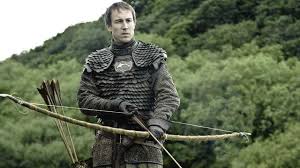
Because Game Of Thrones’ guiding principle appears to be to never stop sprawling, we get to know several recent additions better this week, in addition to meeting some of the Tullys.  Michelle Fairley has another strong, ruminative scene with her uncle Blackfish, but really we learn everything we need to about the new folks in the dryly comic opening scene.  Cat’s brother Edmure (played by Tobias Menzies, which means that GoT now employs both Caesar and Brutus from HBO’s Rome) can’t hit his father’s funereal raft with multiple flaming arrows, so Blackfish pushes him aside to brusquely do the job in one shot that in true badass fashion he doesn’t even bother to watch land.  It’s almost superfluous when we find out that Edmure has been screwing up Robb’s plans to trap The Mountain with short-sighted forays.  After that opening, of course he did.

edmure

Another Stark bids goodbye to a loved one (or at least a grudgingly tolerated one) as Hot Pie peels off to pursue his passion for baked goods full time.  It’s a surprisingly sweet scene that highlights just how much of a kid she still is, but let’s be honest…Hot Pie is totally going to turn up dead next time the show circles back to this inn (the same one, Arya, notes, where the Hound murdered the butcher’s boy in the second episode), right?  The Mountain is going to ride through there looking for his brother or something, and burn the place to the ground.

She still has Gendry with her, at least, though trouble seems to be heading his way as Melisandre leaves Stannis with the stated intention of seeking out Baratheon blood to fuel another shadow baby (the blue shell of Westerosi warfare) with Joffrey or possibly Robb’s name on it.  The Dragonstone scene is brief, but at least seems to imply that Davos is not going to be roasted alive in the immediate future, which I think qualifies as good news by the show’s standards.  It also provides a service in explaining why the Red Woman can’t just keep firing shadowbabies at all of Stannis’s enemies willy-nilly, while keeping the logic of it sufficiently mystical so as to not rob the magic of all the, you know, magical feeling.

He may need to redirect his heat-seeker by the time he gets it, though, since Mance Rayder has reached the Wall and commenced with a plan to infiltrate Castle Black.   His wildling army may be the biggest problem facing the would-be kings of Westeros, unless Jon Snow can pull a John McClane and disrupt the plan from the inside.  But does anyone really have much faith in Jon Snow’s abilities without Ghost to bail him out?

jon

The more interesting material north of The Wall is actually centered on Sam, who has defaulted into our primary hero for the Night’s Watch storyline.  If you don’t love Sam, don’t worry, he’s no more thrilled about it than we are.  Craster singles him out for mockery, and while he doesn’t say anything too different from how his brothers’ have taunted him for in the past, it provokes murderous stares from the strung-out Crows.  The Watch may be a motley assemblage of crooks and cast-offs, but they seem to be a real brotherhood to the extent that they jealously guard the right to abuse their members as their own.  Having seen his crush giving birth to a doomed baby boy, Sam seems poised to push Craster over the edge, and while the wicked seem to mostly prosper in this series, I don’t see it turning out well for him.  He can talk all he wants to about being square with the “real” gods, but he’s due for reminding that two dozen armed men in your home require as much appeasement as even the most demanding of deities.

Due to learn a similar lesson is Master Hostiledouche of Astapor.  Dany has decided to use the Unsullied after all, following a convincing case from Jorah that whatever atrocities were committed to create them, the result is a more humane weapon of war than a conventional army, which has to run on the bloodlust (and plain lust) of “ordinary” men.  That does not mean that she is cool with slavery, though, or that she’s dumb enough to have missed the insulting manner in which Master Houstiledouche has spat every sentence at her, or that she is willing to part with one of her dragons.

 kraz

There is a slightly bum note here, in that it makes Jorah look kind of dim for thinking that the Khaleesi would possibly give up one of her “children” to obtain an army she was deeply ambivalent about using in the first place.  He was there last year when she braved the House of the Undying to recover them (over his own protests), and should know better than anyone that she would not part with her birthright for anything.  It makes Houstiledouche look pretty dumb too, but he is dumb and fuck that guy.  He deserves to have his city burnt to the ground the moment he trades 8000 unquestioning warrior slaves for one fire-breathing lizard that probably lacks comprehension of the subtlety of chattel transactions.

Speaking of transactions (and five-star segues!), back in King’s Landing Tyrion is saddled with a dubious promotion to Littlefinger’s former role running the royal treasury, and is both dismayed at what he finds in the whoremonger’s accounts and confounded by the behavior of his employees when they refuse payment for servicing young Podrick.  I’m assuming there is some deeper play by Littlefinger at work, if only because I can’t see such an overstuffed show finding several minutes to devote to Tyrion and Bronn putting a deceptive bow on the kid’s present, or to reveal that a minor character like Pod really does have the sort of magic, life-altering wang that (all) rappers attribute to themselves in (all) rap songs (ever).
pod

In any case, it’s a great day for Pod, but a great episode for Tyrion.  He may not be happy with his new position, and may in fact be getting set up to somehow take the fall for years of Tywin and Littlefinger’s Ponzi-scheming, but there’s no way a spreadsheet is going to take him down where the combination of Stannis’s fleet, the Hound’s desertion, and Cersei’s assassin couldn’t.

But it say something great about this show that I’m as stoked to see Tyrion sort out the Crown’s finances as I was to see him plan siege defenses, and that just seeing the Small Council gather in a room with Tywin got my heart pumping as much as any battle scene.  The silent comedy of the councillors racing to sit as close to the man as possible, followed by Cersei dragging her own seat around to his right hand, followed by Tyrion carefully moving his seat as far away from the old man as possible was wonderful.  Along with Pod’s big day and the viking funeral, it made for probably the funniest episode of what is generally a rather humorless show.

It was not all sweetness and light, however, as the material with Brienne and Jaime in captivity takes a quick, very dark turn from their odd couple banter (though it was nice to see her take a turn heckling him) when he points out that she does not hold any value to them as a hostage, but that doesn’t mean they don’t have use for her.  He seems to tell her this out of a genuine concern, even as he knows that she will not heed his counsel to let them have what they want rather than getting herself killed resisting.  Of course, if he thought she would take the advice, he probably wouldn’t respect her enough to give it.

 brienne

Jaime has become more and more likeable as we’ve gotten further and further from his attempted child murder, and as he’s been held in such a vulnerable state during his long captivity (it also helps, at least for me, that he’s the only Lannister that shows any regard for Tyrion).  And he is only going to be more vulnerable going forward without his swordhand, the one thing that made him remarkable outside his father’s wealth.  But then, it wouldn’t be Game Of Thrones if he wasn’t horrifically punished immediately after he performed his first really selfless act.

I loved a lot about this twist, though.  It established Locke as a formidable and ruthless antagonist, and gives Jaime interesting new places to develop as a character.  It was staged well, leading you to think for a minute that he was going to take out an eye before going for the hand.  And it was precisely the type of shocking, brutal development that Game Of Thrones specializes in, and makes me groan every time the credits roll (out of place song or not).

game

Is it next Sunday yet?  Oh, come on!

Monday, April 8, 2013

GAME OF THRONES 3.02 - "DARK WINGS, DARK WORDS"

GoT
Programming Note:  These reviews will be written from the perspective of someone who has not read the books.  So we’re not going to mention the books, at all, and would ask that the comments don’t either.  Thanks to all you literate mofos in advance.  Also it means I’m going to misspell some names.

“Dark Wings, Dark Words” is another highly scattered but highly entertaining installment of HBO’s current magnum opus.  This week we have to do without anything at all relating to the Dany or Stannis storylines, and even with significant goings-on in King’s Landing, there’s no sign of Tywin, Bron or any of the Small Council.  And only one scene with Tyrion, because apparently that is the minimum amount of Dinklage the FDA will allow for public consumption in a single serving of Game Of Thrones.

 tyrion
 A dangerously lax standard, in my opinion

We also only took a brief stop beyond the wall this week, without much that could be mistaken for narrative progression (and alas, no FUCKING GIANTS).  Sam is still a liability, and Jon is still marching with the Wildlings, still finding new things to not know things about.  This time it’s wargs, people who can possess animals.  Gareth from The Office is one, as is young Brandon Stark.
Well, maybe not so young anymore.  It’s a bit awkward that Bran’s voice has changed overnight (in story time), but such are the realities of making television, I suppose.  We’ve known or suspected that he had such abilities for some time, so the bigger development on this front is the appearance of Jojen and Meera Reed, young siblings possessed of preternatural composure and in Jojen’s case, The Sight.  I don’t know what’s in store for these new characters, but I worry for their safety once he’s taught Bran a little about how to warg it up; narratively speaking, how much use is there for two seers in one storyline?  Bran and Rickon have never grabbed me too much as characters, so I hope that the new kids stick around and continue breathing some life and intrigue into that plotline.

 jojen
 But my own psychic powers say the 
average  gueststar has maybe 3 episodes 
between introduction and brutal murder
 
All the Starks are on the move as well, and some of the funnest parts of the episode involve Arya, Gendry, and the roly poly they cart around with them encountering the Brotherhood Without Banners.  We heard a fair amount about the Brotherhood last year, but hadn’t seen them, and I like them a good deal already.  Anyone who gave Tywin and The Mountain so much trouble is obviously doing something right, and they have personality and style, particularly the archer that threatened the fat boy with a move that would’ve felt right at home in an episode of Justified, and brought the Hound in to blow Arya’s cover.

I am glad to have The Hound in the mix again, though I’m a little confused as to his current position.  He seems on almost friendly terms with the Brotherhood’s leader, but given their enmity of his House and their masters, I doubt they’ll just be sending him on his way.  Which is great, because I want to see Arya and the Hound interact for at least a few episodes.  He is on her official shit list for standing by while her father was killed, but he’s a fugitive too now and would actually make a natural progression in her string of martial mentors, from the largely academic exercises with her “dancing master” to the murderous but courteous and professional Jaquen, to this hulking beast who just likes killing because it’s what he’s good at.  Of course, he’d say that was all it really was for the other guys anyway, whatever artsy terms they used to dress it up.  And The Hound’s sentiment can be awfully hard to read, so who knows if any warm feelings he had for her sister that will carry over.

Speaking of the sister, Sansa gets some of the best scenes of the episode, although that’s mainly down to Diane Rigg’s straight-shootin’ Tyrell matriarch Olenna.  She makes an immediate impression, disarming Sansa by running down her own family and appealing to her inherent Stark-ness, which compels the poor girl to honesty when every sensible cell in a person’s body should be screaming at them to just keep their mouth shut.  It’s not even that I think the Tyrells mean her any particular harm, I’m just dead certain they will sell her out the very second there’s anything to be gained from it.

 orella
 “I was too much woman for your grandfather in 
the 60s. I am still too much for you now.”

The Tyrells make the biggest impressions of the episode, as the old lady is clearly a force to be reckoned with, and no wilting flower to judge by her drier-than-burnt toast reaction to the news that Joffrey is, to put it lightly, a monster.  It’s hard not to love the old broad right away, and as much as I’d like to see some of the badass warriors the show has accumulated face off against each other, right now the clash I’m most eager to see is the epic snipe-off sure to ensure when she meets Varys.  Her granddaughter, meanwhile, gets the most unsettling scene, as she quickly adapts her seduction attempts with Joffrey to his particular lusts, which are less sexual and more sadistic.  I like Marge, I think, but she has very quickly revealed herself to be a serious contender for most dangerous person in King’s Landing, no mean feat with the likes of Tywin, Bron and Cersei slinking about.

 mar
 Ah, isn’t that…stomach-turning?

Meanwhile,….somewhere, Theon is being tortured, by…someone.  There’s not much else to say about this since we’re as in the dark as he is about the where and who and why of it, but I have a suspicion that the guy claiming to have been sent by his sister to help him is really just there to add a psychological element to his torment by dangling hope in front of him.  But whatever the motivation, it’s not like he didn’t earn a few thumbscrews and what have you.  You can just go ahead and rot there for a bit, Theon, and your sister can come save you once we’re completely sure there isn’t something else we’d rather be watching her do.

But the episode, in contrast to the last one, saves the best for last, with the latest installment of Jaime and Brienne’s odd couple road show.  I love this stuff, as Gwendolyn Christie and Nicolaj Coster-Waldau have a mismatched chemistry that brings a completely different tone to their scenes than the rest of the show, in the best way possible.  Plus it gives us a chance to see two of those badasses I was talking about throw down, a treat we had been denied since Jaime and Ned dueled early in season 1.  Jaime is not at his best, of course, being manacled and having spent a good portion of his time lately lashed to a post and shitting in his pants. But it’s a great bit of fight choreography anyway with some nice character shading with how she is all business while he can’t stop needling her even when he’s losing.

brienne

In a way, they both lose the fight, as before Brienne can re-secure her prisoner, they are found by a hunting party of House Bolton, Robb’s most ruthless bannermen, who were tipped off by a passerby that Brienne was not ruthless enough to murder just in case he went and did exactly that.  This is bad news for both their plans.  But good news for me, because it will keep them on the road together a bit longer, preserving what is currently my favorite dynamic on the show.

Is it next Sunday yet?  Oh, come on!

game

Monday, April 1, 2013

GAME OF THRONES 3.01 - "VALAR DOHAERIS"

Programming Note:  These reviews will be written from the perspective of someone who has not read the books.  So we’re not going to mention the books, at all, and would ask that the comments don’t either.  Thanks to all you literate mofos in advance.  Also it means I’m going to misspell a lot of  new names.

It’s good to be back in Westeros.  Well, maybe not so much “good” as “harrowing and occasionally sickening,” but nonetheless, this was my most anticipated pop culture event of the year (at least until Breaking Bad returns for its home stretch), and it did not disappoint.  We are welcomed back with our first pre-credits sequence since the pilot, which also featured a White Walker attack.  When the credits do kick off, we are treated to about a dozen new names, a new map section in Astapor and a nifty effect of a ruined, smoking Winterfell.

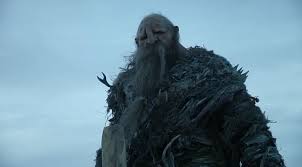
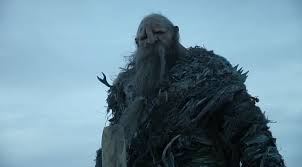
After that it’s a whirlwind tour to reintroduce us to as many of the main characters as the show can fit into an hour, with easily half a dozen important folks (Arya, Theon, Varys, The Hound, Bran and Osha, Brienne and Jamie) not even making the cut.  But we did get to see ice zombies, warlock children, flying, fire-breathing dragons, armored super-soldiers and FUCKING GIANTS.  I love this season already.

giant

Seriously, I outright cackled with glee at the matter-of-fact presentation of the giant in the Wildling camp.  It’s hard to tell when we’ll get a pay off to that, as the show hasn’t been in any big hurry to pack episodes full of dragon/zombie action even after they introduced those creatures; heck, even the army of Walkers we ended last season on is back to being an off-screen threat. Presumably in a year or two they’ll lumber their way into the vicinity of some characters we care about.

But I’m not even griping about that, since watching those characters bounce off each other is as gripping as ever, giants or no.  Staying north of the wall, Jon Snow has never been my favorite character, and the Night’s Watch storylines always felt like they were treading water until the high fantasy elements are ready to really kick into gear.  This episode was immediately promising, though, with the introduction of the very-welcome Cirian Hinds as the King Beyond The Wall, and his lieutenant Toman Giantsbane, which sounds like the Westerosi version of a porn name.
Rayder seems pretty sharp, so I’m not sure how much he’s buying Snow’s act, but the bastard did make a surprisingly cogent case for why he should want to ditch the Crows and fight for the living (who will let him touch girls).  I’m sure he’ll come down on the side of his oaths and duty in the end, being his father’s son, but fraternizing with his pretty new friend will surely lead to some angst about the whole deal in the weeks to come.  Also, there’s giants and Cirian Hinds.  This automatically makes this episode’s Jon story better than the last two years.

rayder

Also immediately more promising than last year is Dany’s plotline, which has her taking definitive steps toward taking back the Iron Throne.  Last season let her languish in Qarth the entire time, which while stylishly presented, was uneventful enough to feel like the narrative shallow end compared to all the goings on around the capital.  I may be alone in thinking this, but to me the least interesting thing about her is HER DRAGONS! (as she was good enough to shout for us a few dozen times last year).  So I like that she’s recruiting the Unsullied to get things going, which suggests that she’s going to rely mostly on more traditional forms of medieval warfare to invade Westeros rather than just riding a dragon straight into the throne room.  The Unsullied may have a slightly fantastical tint to just how thoroughly robotized their training makes them, but they are in essence a mercenary force, that can be fought and killed by the soldiers of any of the other various warlords of Westeros.  Full-bore dragons seem more like bringing F-22s to Agincourt, and has the potential to tip the balance way too far in Dany’s favor, when what I most want to see is her jockeying for position on roughly equal footing with the various Lannisters, Tyrells, Starks and so forth.

Dany also gets a boost just for getting closer to her ultimate goals, and having finally found another established character to play off of with the arrival of Barristan Selmy on her side of the pond.  Not that Jorah is ever less than great, but since Drogo fell from his horse her plots have been filled out by thinly-sketched members of her entourage and placeholder antagonists. But I will say, as interesting as the stuff with the Unsullied and the revelation that the warlocks of Qarth are not done with her yet was, the one mistake I think the episode made was ending on Selmy’s reveal.  I gather that he’s hot shit because all the book readers immediately responded to him when he was first introduced, but as far as the show goes, he simply hasn’t been enough of a presence for this to land as a major dramatic turn.  He’s been name-dropped more than he’s appeared, and I think it’s been a full year since he did that; the scene where Cersei and Joffrey take his sword from the “previously on” recap may have been from last year’s premiere, but I want to say it was actually back in season one.

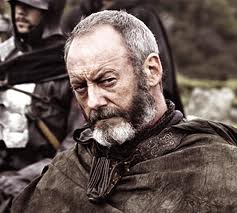
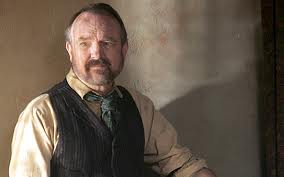
A better note to end on would’ve been Stannis having Davos dragged off to the dungeons and presumably scheduled for religious BBQ-ing.  That’s a character and relationship we’ve spent more time with, and it promises an immediately dire result that “hey…that guy!” can’t match as far as cliffhangers go.  I’d forgotten how great Liam Cunningham is in the role, and what a shame it is that no one has cast him and Jim Beaver as brothers in some sort of blue-collar family dramedy thing.

liam
 beaver

Stannis himself is looking run down and crazier than ever, and I’m not sure whether I buy Melisandre’s claims that she could’ve turned the tide at Blackwater.  But you know, once the horde of frozen zombies makes its way past the Wall, I think people might be more open to the ravings of a fire witch with a messianic warrior all ready to launch.  Still wouldn’t want him for my king, but for someone who looks to be near rock bottom, I think events are percolating that could give him another shot at the title.

But for now, and as usual, the best material is centered around King’s Landing, where the highest concentration of schemers and plotters and other totally different sorts of people are based.  Joffrey’s still wearing the fancy hat, but newly humbled after his pathetic showing at the Battle of Blackwater has lowered his respect level even further than when he was getting pelted with cow pies last year. Even humbled Joffrey is still immensely hatable, of course, sniping at his mother and being carted around the city in his ridiculous gold box.

Luckily for him, although it’s extremely doubtful that he realizes it, his new bride-to-be seems to recognize that he needs some PR turnaround at a grassroots level.  Marge Tyrell hasn’t had a lot of screentime previously, but she seems to be a match for Cersei when it comes to politickin’, and Natalie Dormer has been great so far, so I’m looking forward to her taking on greater prominence as the things move forward.

dormer

Elsewhere in the capital Bronn is, improbably, getting more awesome.  He’s no longer in charge of the City Watch, but he’s an anointed knight now and that just gives him more time to wile away in Littlefinger’s brothel.  He’s short on money, but that shouldn’t be an issue at least until Tyrion figures out how much he pays him anyway.  And he still has the ability to trigger a deus ex reprieve from a deadly confrontation just by reaching for the knife on the back of his belt, which seems like a useful trick.

Tyrion, meanwhile, has managed the tricky feat of succeeding downward.  Having saved the city and survived his sister’s assassination attempt, he’s enjoying exactly no glory to go with his nasty new scar and has been stripped of his power as the Hand of the King.  Even his father, who is nothing if not pragmatic, won’t spare him any credit and certainly won’t appoint him lord of their home manor.

dance

The scenes between Tyrion and his sister and father are upsetting, since he’s easily my favorite character and he’s mostly getting abused in them.  But they’re also the best of the episode, as Dinklage, Headey and Dance are (as always) uniformly fantastic.  God help me, I hope to never in my life receive a dressing down from Charles Dance.  The only thing better than his crushing of Tyrion’s hopes is the little nod Dinklage gives before he can finish his threat that “the next whore I find-”

 giant
Game Of Thrones episodes are patchwork beasts made of a half dozen disparate storylines, so they have a way of just ending on you suddenly, which “Valar Dohaeris” did.  That would be a serious criticism, if I wasn’t so rapt through every single scene of the episode, or rabid to see the next.  And not just because there’s every chance it will have FUCKING GIANTS in it.


Seriously, fucking giants.

Saturday, February 23, 2013

TORTURED LOGIC: THE UNSETTLING POLITICS OF ZERO DARK THIRTY

(This piece was originally published on Chud.com)


Zero Dark Thirty is up for a lot of Oscars this weekend.  It is also one of the most controversial movies in years, and one I have been mulling over a lot since I saw it.  It is a powerful, expertly-crafted piece of cinema, full of great performances and a climactic sequence that will likely be remembered and clumsily imitated for years to come.  It is, without a doubt, a Great movie.

But being Great is different than being Good.  Greatness speaks to the magnitude of an achievement, whereas goodness speaks to the inherent worthiness or nobility of that achievement.  And there’s a nagging possibility that Zero Dark Thirty is, like Oz, Great and Terrible.  It is of course possible to be both – it’s pretty much conventional wisdom at this point that movies like Triumph Of The Will or Birth Of A Nation were technical and innovative triumphs in service of repugnant themes.
Not that ZDT is on the level of those movies; it’s far too thoughtful and ambivalent about its own characters and content to be placed in the same category as straight up nazi/KKK propaganda.  I only bring it up to clarify that acknowledging the film’s considerable technical merits is a separate matter than judging it’s thematic content.  To sort out that whole mess, I’m going to need to talk through my personal beliefs as they relate to torture, the debate surrounding it, the manner in which movies affect public discourse, the responsibilities of an artist to society at large, and how this movie pits all of them against each other in some sort of moral-rhetorical Thunderdome.

And spoiler alert, I’m like, fully liberal, so if you aren’t you may want to take a quick drink and steel up your sensibilities, because the next bits may produce mild chafing.  The funny thing is, even if you disagree with the political views I’m about to espouse, the later sections are probably even more relevant to you, as you likely face the same sort of issues ZDT raised with me on some small or large scale with most movies that come out of the Gomorrah of Southern California each and every year.

ON THE MORALITY OF TORTURE

Torture is wrong. Full stop. And yes, waterboarding and other “enhanced interrogation” techniques are torture.  In the last 10-12 years we’ve pretended there is legitimate debate over this issue, when in fact it has all been clearly decided for over a century – US soldiers who waterboarded prisoners in the Phillipines were court martialed and the general who authorized it was dismissed from the Army by Teddy Roosevelt, even before we spearheaded the Geneva Conventions codifying torture as against international law,  and before we executed Japanese soldiers who did it for war crimes following WWII, and before our generals specifically designated it illegal again during Vietnam.
(note – This being an opinion piece and not an academic paper, a couple links are far from the definitive word on the subject.  I threw them up solely to demonstrate that I’m not pulling this stuff directly from my ass)

It has been a great moral failing on America’s part to have allowed the use of these techniques to be defended as valid methods of prosecuting the War On Terror.  I understand the reasons it happened, and there have been moments when I felt myself waffling on whether it was maybe okay to do it a little bit to people who really, really (probably) had it coming.  But I don’t kid myself about my motivations in those moments:  it’s not because torture is a tricky grey area, or because there are legitimate questions as to whether the types of abuse depicted in ZDT actually constitute torture.  It’s because I was scared.  That’s it. I was scared shitless following 9/11 and I wanted to be reassured that everything that could be done to stop it from happening again was being done.  I wanted to know that our protectors were going to Great lengths, even if they were Terrible ones.

But as a nation, I think it is fair to say, America should always be stronger than I am in my most cowardly moments.  And I believe the true measure of strength is in how we live or fail to live up to our professed ideals, and not in the scale or severity of damage we are capable of inflicting.  For the entire lifetime of the majority of Americans, we have possessed the power to destroy literally the entire world several times over if that was what we wanted.  We know no end of ways to inflict agony upon a helpless person.  We can do these things, easily.  It is the restraint not to do these things, even when frightened or provoked, that makes us great.

Maybe that’s too high-minded.  Perhaps it really boils down to this: the argument that we have to do these things to defeat this enemy strikes me as an admission of weakness.  I mean, motherfuckers came at us with box cutters.  I’m not saying shit isn’t serious, but if we’re so damaged by it that we don’t know how to hit back without shredding the Bill of Rights and Geneva Conventions, that to me tastes like admitting that we weren’t such hot shit to begin with.  It’s saying “look, we just aren’t strong enough to handle this unless we do all that stuff we told everyone was unacceptable to do no matter what the circumstances.”  I think that’s bullshit.  And no excuse anyway.  If your standards only apply when you are not under pressure, then guess what, you don’t actually have any standards.
I should really have just linked to Seanbaby and Batman making the same points in much more concise, hilarious fashion.

ON THE ACTUAL TORTURE DEBATE

That’s all well and good.  But while it’s all the reason I need to oppose torture, I also recognize the fact of the matter is that most Americans do not agree with me, or at least don’t feel very strongly about it.  So a great deal of the actual debate on the issue revolves around the murkier area of whether torture actually works as an interrogation technique.  For my part, I believe that torture is effective at getting you a lot of information, and fairly quickly. The question is whether you get accurate information from it, which (spoiler) in the movie it does.

ZDT, to be fair, actually does raise this issue in a brief moment or two, such as when it is eventually revealed that the identity of the courier Maya has been searching for has been in the CIA’s records for a decade, but no one else had been able to parse its significance amongst the flood of leads and info they gathered post-9/11.  I don’t think this is enough to introduce real ambiguity into the film’s presentation of torture, though.  If the sharpest critique of torture is that it is so effective that it’s difficult to manage the surplus of information it produces, I think you came down pretty squarely on one side of that issue.

There are other practical arguments against torture, of course.  But the film doesn’t touch at all on the effect a sanctioned torture program has on our standing in international affairs, how disastrous it can be when it produces bad intel (rather than useless info like the prisoner shouting random days of the week, which is a wash that leaves our heroes where they began), how it encourages our enemies to fight to the death rather than surrendering, or how even if only applied to foreign “non-lawful enemy combatants”, it sets an example for domestic law enforcement in how they might deal with especially difficult or unsavory subjects (if that seems like a stretch, there are documented cases of police departments using these techniques on citizens, including waterboarding, stretching back to the 1930s and further).

That’s not really a fault of the film, though, as most of that stuff lies well outside of the intently focused story it is telling.  It does not present a well-rounded overview of the torture debate because it is not trying to be a movie about torture.  And it isn’t, exactly, but it is a movie that condones torture.  I’ll return to that distinction and why it is significant in the next section.

The point is, while I hate that the argument over torture is based so much around whether it works rather than whether it should be beneath us as a people, I accept that as a practical reality.  America is far too accepting of torture in my view, and anything that makes it seem more like a reliable method of intelligence gathering is only going to exacerbate that problem.  Zero Dark Thirty does suggest that the use of torture was effective.  At the very least, it demonstrates that interrogations “enhanced” by prior acts of torture led to the major breakthroughs that led to Bin Laden. If you’re not apt to read between the lines even that much, it presents torturing prisoners as point A and a dead Bin Laden as point B, and the basic, inescapable logic of narrative cinema suggests that what happens at the end of a movie is the result of what happened in the beginning and middle.

This makes ZDT a pro-torture movie, because it ends with Osama Bin Laden dead.  And as much as the film goes out of its way not to sugarcoat the brutality of the operation (and somehow manages to make an utterly gripping sequence out of it without resorting to blatantly manipulative jingoism – don’t ask me how the hell they pulled that off) it’s impossible to desensationalize these events.  It is still the triumphant culmination of the hero’s struggles throughout the film, even if the final shots suggest that she feels somewhat hollowed out by finally achieving it.  If the intention there was to make the audience question whether the lengths she/we went to in order to get Bin Laden were worth it, I don’t think it succeeded in actually planting those doubts in anyone’s mind.

And look, even my bleeding-heartiness has limits; I’m not suggesting that this shouldn’t be in some way triumphant, or that the raid itself was wrong.  I’m against the execution of criminals without trial, but…well, it’s not like the guy was proclaiming his innocence or anything.  When you publicly take credit for the mass murder of American citizens and declare open war on the entire country, I’m totally cool with the gloves coming off.  Dude asked for a war, and that means less trials and more Black Hawks.

Anyway, the point I was making is that by the movie’s and vast majority of the audience’s estimation, killing Bin Laden = Good, so the movie depicts torturing people as producing a good result.  And the majority of America, whether they think we should be using it currently, does believe on some level that it’s use on Al Qaeda suspects was justified.  This is in no small part because the ends of those particular means included the eventual death of Bin Laden.

Given all those givens, the movie is ultimately pro-torture.  It may be agnostic as to the morality of the enterprise, but it comes down strongly on the side of its effectiveness, which realistically speaking is the area that plays the largest role in shaping the opinions of the general public.

SO WHAT? IT’S JUST A MOVIE

Okay, so let’s pretend that you agree with me that torturing people is bad and that the movie encourages its acceptance as legitimate tool of intelligence gathering.  The next question becomes so what?

So this creates a conundrum for me, the pinko movie geek.  I’m completely against censorship of any kind, but one of my biggest pet peeves is people crying censorship when they are simply being criticized.  Here’s the important distinction:  only the government can really censor things.  Nothing else is actually censorship; a network, studio or publisher isn’t required to help anyone distribute their works if they don’t want, and when people make fun of how stupid and terrible your ideas are, they are not infringing on your right to free speech, they are in fact exercising theirs.  So for the love of God and my own sanity, stop going online and whining “I thought we had free speech in this country???” every time some politician or celebrity catches flack over saying something idiotic.  We do have it, idiot, which is why we’re free to call idiots idiots when they’re being idiots.

This is not about censorship, it is about criticism, and while any time you say “this is bad” it carries with it the implication “…and they shouldn’t have made it,” that is very different from saying “they should not have been allowed to make it.”  I am not saying that Bigelow and Boal shouldn’t have the right to make the film they want, I’m saying that I wish they wanted to make a different one, in particular because they’re so goddamn good at it.

And I really don’t even want to do that, because part of my godless liberal agenda is to allow artists to make whatever art they want.  And I am generally contemptuous of the pearl-clutching mindset that would hold violent movies or video games to blame for whatever fresh horror some lunatic has found a way to inflict on his fellow men.  I don’t believe that is true, or that depiction of horrible or disgusting acts amounts to endorsing them.  I’m not worried about a rash of kids waterboarding their little brothers in the backyard, nor am I particularly worried about anyone who opposed torture being persuaded by the movie to switch their position.  Hell, I don’t even think “torture works!” is the primary theme of the movie, which tries pretty hard at not having a discernible opinion about it.

But one thing that always feels a little off with me is that when us fans of dark and violent entertainments sneer at the pearl-clutchers, we’re can be so quick to dismiss their position as silly that we end up denigrating the artform we love.  In our eagerness to distance our beloved slaughterfests from the actual slaughter of an Aurora or Newton, we end up in essence saying “they’re just movies!  They don’t actually matter!”

Which is ridiculous. I don’t think movies implant violent urges in otherwise peaceful people, but if they are really incapable of impacting people in a significant way, then why do we spend so much time watching and analyzing them?  Boring friends, family and strangers at bars with exhaustive diatribes about what a shitty script Prometheus has or how Jackie Brown is actually Tarantino’s strongest film despite being his only flop?  Spend our free time writing 4000 word essays about them on websites that take their name from schlocky horror flicks?

We wouldn’t, if we really believed that.  But we don’t.  We know movies matter.  Maybe not on the level that stuff like genocide, climate change, your mother’s love or a double shot of tar heroin on a cold Christmas morning matter, but we care about movies because they affect us powerfully.  And if something can affect us positively, it also has the ability to affect us negatively.  It has to.

But the question is really about how movies influence us.  As I said before, I don’t think they inspire acts of violence, and I don’t think that most movies that set out to sway people’s opinion on a specific subject really have much of an impact.  “Message” movies don’t change many minds, imo, not that ZDT is a message movie. No, I think that movies influence the public consciousness most powerfully not by way of the conclusions the story draws at the end, but in terms of what they take for granted while getting us there.

Let me give you a couple for instance-s.  To use a very specific example, I don’t think a ton of people are walking around fully accepting the conspiracy theory that JFK puts forward as the real truth of the assassination.  But I do think a lot of people have a totally warped view of who Jim Garrison was due to Costner’s portrayal.  To use a very general example, I think movies have been very influential in making overt racism more and more socially unacceptable over the years.  But I don’t think that is because so many racists saw Driving Miss Daisy or Crash and walked out thinking “man, that’s it, I’ve got to cut back on all this racisting.”  Don’t get me wrong, maybe movies like that did lead some people to examine their prejudices to some degree, and that’s great.  But I think that ultimately it wasn’t movies that set out specifically to end racism that succeeded in shifting the Overton Window, so much as a hundred other comedies and action movies and whatever that started using racism as a casual shorthand for establishing villains and assholes.  Those less ambitious flicks normalized the idea that racism = bad in a way that didn’t really brook argument, because the movies weren’t trying to build up to that point, they simply took it as a given and never stopped to let you think about whether to accept or reject it.

Which, I worry, is what ZDT will do for torture.  Again, I don’t think it’s going to change the mind of anyone who already agreed with me, but there is a very large portion of the population that is not enthusiastically pro-torture, but is sort of okay with it as long as they don’t have to hear about it too much.  A high profile movie reinforcing the idea that these practices get major results is only going to make it easier for those people to quietly tolerate it, even if it never comes out and tells us that torture is great.  In fact, it’s to the film’s credit that it doesn’t tell us anything about these highly charged real life scenarios.

But the most basic maxim of moviemaking, after all, is “show, don’t tell.”  And not for nothing; commentary of any sort raises our mental guard.  When a movie tells us something, we can choose to reject it.  But what they show us has a way of slipping past our defenses and influencing us in subtle, surprising ways.

WHAT SHOULD THEY HAVE DONE INSTEAD?

Complicating this issue further is that I have no idea how Bigelow and Boal, were they interested in catering to my personal political views (while obviously having no obligation to do so), could’ve addressed these issues while making essentially the same movie.  Because I take them at their word that they do not personally support torture, and that their goal was to tell this story as truthfully and objectively as possible.  They didn’t set out to make an apologia for enhanced interrogation techniques as a valid weapon in the War on Terror. They actually wrote an entire script before anyone knew what Seal Team Six was.  They were about to start production under the title Tora Bora, with the climax being the failure to capture Bin Laden in the titular valley a decade earlier, when Obama came on TV to tell us that we got him.

And I don’t know what the hell you do with your movie at that point.  Sticking with the original version isn’t an option.  Grafting a different finale on a movie that was initially about the failure of these tactics completely changes the thrust of the entire piece, and brings up all the issues I’ve been going over. Scrapping it and coming at it entirely from a new direction goes against your stated purpose of telling a true story as objectively as possible.  It would be admitting that no matter how conscientious you are about getting the facts right, you’re still manipulating the audience’s response to them by how you present them, how you choose what to focus on and ignore or omit.  That’s a thorny issue even for documentarians who have to edit entirely unmanipulated footage into a coherent narrative.  But these two especially seem intent on making highly realistic movies about hot button political topics while retaining a staunchly apolitical pose. It is just a pose, however; I don’t think you can engage meaningfully with such charged political issues without taking some sort of stance on them.

But it is important to note, I don’t think Zero Dark Thirty in its final form is factually inaccurate or even dishonest.  It’s probably much more accurate than most movies sporting the “based on a true story” label are, and as it applies to the issue I’m focused on, it does have the broad strokes correct.  There was a program of systematic torture in place within the intelligence community for several years, and eventually that intelligence community was successful in finding and killing Bin Laden. 
That does not justify it; certainly not morally, but even in terms of efficacy.  It took over a decade to produce that result, after all.  Maybe the leads that led to the Abottabad compound would never have been uncovered at all without torture.  Maybe we could’ve produced the same information with a cleaner interrogation program, but it would’ve been slower coming.  Maybe it would’ve been faster.  Maybe it would’ve been faster and the wars in Iraq and Afghanistan wouldn’t have burned as hot and long as they did.  We can’t know any of it for sure, because history only happened one way, and what it tells us is that abusing detainees didn’t stop us from (eventually) getting to him.

The distinction between correlation and causation is something we can debate in the real world.  There is simply not room to parse out that distinction in a narrative film depicting these events, however, because as I went over before, that structure is built on basic, powerful assumptions of cause and effect.  The type of assumptions that bypass our conscious critical faculties and appeal to our innate need to impose order and linearity to the mess of information we process every minute of every day.  That need has served us well as a species, as constantly looking for the cause to every effect has figuratively rocketed us to the top of the food chain, literally rocketed us to the moon, and made cheaper, more potent tar heroin available on cold Christmas mornings.

That need to make sense of things is also the basis for storytelling, and the unspoken pact between the teller and the audience.  What makes something a “story” is that it is what happens to the characters (be they real or fictional), but stripped down to the parts that matter.  This goes as much for surrealists like David Lynch as for naturalists like Bigelow.  As allergic as the former can be to linearity in his narratives, every shot in his movies is chosen for a purpose, because he believes it has some relevance to the whole.  And of course ZDT is not a surrealist piece.  It’s a straightforward, focused story, and if we are not to understand that the torture led to Bin Laden, then why exactly does it take up so much of the movie?

So in the end, we’re left with a movie that reinforces the dominate narrative of the torture debate, that it might be messy but damn it, it works.  Which is a message that I find to be genuinely harmful to our society.  So I wish it hadn’t been made.  But I would never want to stop it from being made.  I don’t want to hate it, but I can’t make myself like it.  And round and round it goes.

That’s not much of a conclusion, though, so I’ll end by saying this to anyone who loves the movie and thinks I’m an idiot for worrying about this stuff:  defend the movie, call me stupid, call my politics dangerously naive, tell me none of my opinions matter because I have no right to tell the filmmakers how to make their art.  Just don’t tell me that ZDT doesn’t have a stance on torture.  And definitely don’t tell me “it’s only a movie.”  Because a movie, that’s a hell of a thing.


TL; DR version:
Great fucking movie.  But kinda awful too.